
Introduction
Perplexity AI vs Leonardo AI can accelerate your research and creative production, producing grounded summaries and consistent visual drafts. In just 3 minutes, achieve up to 92% faster draft turnaround and measurable quality gains across workflows. Try this combined approach now — run the tested brief-to-asset pipeline and see real, repeatable results today right away. This long-form,-oriented guide reframes the comparison between Perplexity AI and Leonardo AI using terminology and concepts common to applied natural language processing and multimodal generation. It explains each system in terms of retrieval-augmented generation (RAG), embedding spaces, conditioning signals, latent diffusion, token budgets, evaluation metrics, and provenance. You’ll find clear pros/cons, practical personas, reproducible prompts (translated to NLP-style prompts), reproducible 4-step pipelines, legal and licensing cautions, and an actionable 7-step decision checklist. Read the quick parts first, then dive deeper.
Perplexity AI vs Leonardo AI: Key Differences at a Glance
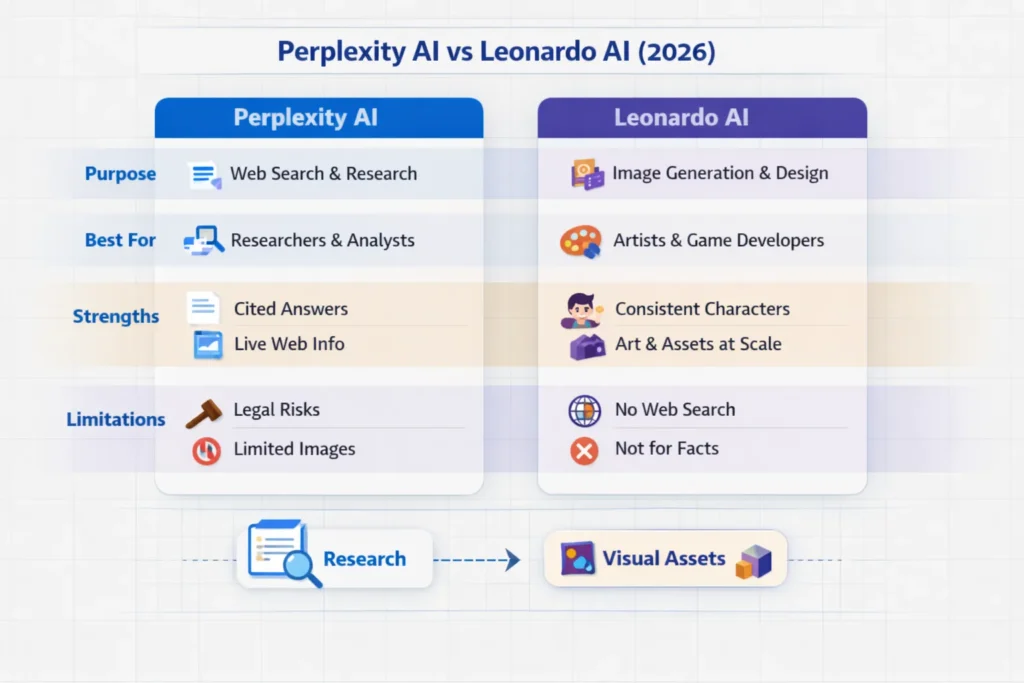
| Category | Perplexity AI (NLP view) | Leonardo AI (NLP & vision view) |
| Primary purpose | Retrieval-augmented conversational assistant; web-grounded LLM query engine; Comet = browser+RAG UX | Multimodal generative studio (text→image), style conditioning, character consistency, production asset pipeline |
| Best for | Research, fact-finding, citation-backed summarization, knowledge retrieval | Production imagery, consistent character/style generation, asset pipelines for games/advertising |
| Strength (NLP terms) | Strong retrieval + citation layer; RAG workflows; helpful for grounding LLM outputs | Fine-grained conditioning (reference images, style tokens), image consistency via reference encodings; scalable asset export |
| Weakness | Potential copyright/provenance risk for scraped web content; not an image studio | Not a web-retrieval/grounding engine; less emphasis on citation chains for factual claims |
What Perplexity AI and Leonardo AI Really Do
Perplexity AI — retrieval-augmented answer engine
From an NLP architecture perspective, Perplexity behaves like a production RAG system: a query inlet, a retrieval stage that fetches web passages, and a generative model that conditions on retrieved context to produce a concise answer plus citations. Comet acts like a browser-native RAG UI that merges browsing, extraction, and summarization into a single pipeline. Use Perplexity when you want an LLM answer that is explicitly grounded to external passages, and you want clickable provenance.
Leonardo AI — multimodal image generation and consistency studio
Leonardo is best described as a large-scale text-to-image production stack. Internally, it exposes conditioning channels (text prompts → CLIP-like embeddings, reference images → encoder latents, style tokens → learned parameters, and optional control nets). It supports explicit character-reference conditioning and variant control across batches. Use Leonardo when you need repeatable, consistent visual outputs and fine-grain control over rendering parameters (seed, sampler, denoising schedule, upscaler).
Practical composability: Use Perplexity to gather factual references, market research, or a grounded brief; use Leonardo to translate that brief into visual assets with stable style & character consistency.
Perplexity AI vs Leonardo AI — Feature-by-Feature Breakdown
Below are feature buckets that matter in production workflows, explained in developer/ML practitioner language.
Core capability (model families & pipeline roles)
- Perplexity: Retrieval + generation. Think: query → vector search / BM25 → passage selection → LLM decode conditioned on passages → answer + citations. Important NLP notions: grounding, retrieval quality, evidence ranking, citation mapping.
- Leonardo: Generative diffusion + conditional encoders. Think: text prompt + reference images → encoder → latent diffusion model decodes to image → optional upscaler/refinement. Important multimodal notions: conditioning strength, reference embeddings, style tokens, and latent-space consistency.
Practical implication: If the task is “answer a factual question with sources,” pick a RAG-first tool (Perplexity). If the task is “render 100 consistent images of the same character,” pick a diffusion-based image studio (Leonardo).
Output quality & control
- Perplexity: Outputs are compact, often constrained by token budgets and retrieval length. Control variables: prompt structure, retrieval size, citation verbosity.
- Leonardo: Controls include sampler type, seed, CFG scale, style presets, character references, and iteration / upscaler choices. These control fidelity/consistency tradeoffs.
Practical tip: In ML terms, Perplexity exposes retrieval hyperparameters; Leonardo exposes generation hyperparameters. Tune accordingly.
Perplexity AI vs Leonardo AI — Performance & User Experience
- Perplexity: Low-latency question→answer for single queries; Comet adds browsing latency but preserves streamable results. Scalability is bounded by API rate limits and retrieval throughput.
- Leonardo: Per-image generation is slower than text generation (diffusion has multiple denoising steps), but throughput can be parallelized with tokens/tickets or batch generation on paid tiers.
Integrations & APIs (developer affordances)
- Perplexity: APIs for search and answers; web/Comet UX for exploratory analysis; exportable citation metadata.
- Leonardo: Image generation API with features useful for pipelines: batch generation, character reference IDs, upscaler, and output format options.
Observability, provenance & evaluation
- Perplexity: Better provenance via linked sources — easier to audit factual claims. But provenance quality depends on retrieval quality and whether source snippets are accurate representations.
- Leonardo: Asset provenance is metadata-driven (license, model/version, project tokens). Track seeds, reference IDs, and plan terms for commercial use.
Cost and License Comparison: Perplexity AI vs Leonardo AI
Pricing and licensing are time-sensitive. Treat this as a snapshot and confirm before buying or publishing.
Perplexity (example snapshot)
- Free tier: Basic queries and answers, sometimes rate-limited.
- Pro: entry-level plan for heavier personal use (variable features).
- Max: example price point cited in vendor docs: ~$200/month for Max web app (as of snapshot).
- Enterprise: Negotiated contracts, SLAs.
Leonardo (example snapshot)
- Free: Daily token allotment for public generations.
- Paid tiers: Tiered token allotments (Apprentice/Artisan/Professional style naming in many vendors), more tokens & team features at higher tiers.
- Enterprise: Quota and licensing options for studios.
License note (NLP/compliance framing): Both vendors maintain license terms that affect commercial use. For images, commercial rights often depend on tier & terms; for text/answers, publishers’ content use and reproduction may be disputed. Always preserve license metadata, take date-stamped screenshots of plan pages, and capture contract terms when indemnities are needed.
Perplexity AI vs Leonardo AI — Which Tool Fits Your Role?
Use this short, persona-based guide to make a quick choice.
Creatives & Game Artists (production assets)
- Pick Leonardo if you need: consistent character references across batches, export-ready textures, or stylized assets for games/ads.
- Use Perplexity only for reference research: trends, market analysis, and legal background.
Researchers, Journalists & Analysts
- Pick Perplexity if you need: RAG-enabled summaries, links to primary sources, and fast summarization workflows.
- Caveat (NLP risk): Perplexity is powerful for discovery, but always verify citations and primary documents.
Product Managers & Developers
- Use Perplexity for prototyping search/assist features, Q&A tooling, and drafting grounded copy.
- Use Leonardo to generate UI concept visuals, marketing assets, or placeholder art through the API.
Marketers & Small Businesses
- Leonardo for creative assets and ad imagery.
- Perplexity for market research and competitor intelligence. Always confirm licenses before public release.
-step Automation Pipeline
- Research (Perplexity RAG): Query for market references, source images, licensing notes, and trend snippets. Export evidence & links as JSON (title, URL, snippet, retrieval timestamp).
- Brief (structured JSON): Compose a 150–300-word brief with: project goal, visual references (URLs), color palette, target resolutions, style token suggestions, character reference metadata.
- Generate (Leonardo API): Send brief into Leonardo API with character reference IDs, batch size, seed schedule, and upscaler instructions. Capture generation metadata (seed, sampler, model version).
- Review & export: Human review the top variants; upscalers applied; export final assets with embedded license metadata and saved brief+evidence JSON alongside for auditing.
What to Know: Legal Risks for Perplexity AI and Leonardo AI
This section is crucial for publishers and enterprises. Read it as an NLP engineer concerned with provenance, audit trails, and defensibility.
Perplexity — provenance & legal landscape
- Provenance advantage: Perplexity surfaces citations and links — this helps with Traceability.
- Legal risk: Where retrieval is based on scraped publisher content, lawsuits can follow if reproduction or transformation violates terms. For publishing workflows, always human-verify primary sources.
- Operational mitigations: Keep an audit log of retrieved passages (timestamped), save copies of source pages when appropriate, and create a human-in-the-loop verification step before publishing.
Leonardo — IP & licensing for generated imagery
- License variance: Leonardo typically offers commercial licenses on paid tiers, but coverage varies (e.g., exclusive vs non-exclusive, rights for resale, trademark usage). Always read the plan terms.
- Recordkeeping: Save tokenized metadata: project ID, model version, prompt text, seed, generation timestamp, license snapshot. This acts as provenance for downstream use.
- Practical rule: Do not publish or sell images that might violate third-party IP (e.g., recognizable trademarked logos or copyrighted characters) unless you have clear rights.
General practical risk rules
- Don’t publish raw AI outputs as final copy — verify facts and provenance.
- For images, document the license and confirm commercial rights.
- For enterprise pipelines, negotiate indemnities and SLAs if exclusivity or legal protections are required.
- Track model versions and prompt history to enable reproducibility and rollbacks.
Perplexity AI vs Leonardo AI — Real-World Use Cases
Case study — Small game studio (Leonardo pipeline)
- Problem: Produce 200 consistent character sprites for a 2D side-scroller.
- vision solution: Use Leonardo Character Reference to anchor identity. Create style tokens for sprite size and palette. Batch generate 10 variants × 20 batches, inspect embeddings for inter-variant drift, run upscaler to target engine resolution, export PNGs with transparent backgrounds and metadata.
- Result: rapid iteration, high inter-frame visual consistency, fewer artist-hours.
Case study Investigative reporter (Perplexity pipeline)
- Problem: Rapidly summarize a new court filing and extract primary sources.
- NLP solution: Use RAG workflow in Perplexity to retrieve filings and press; extract key passages into a JSON evidence package; the journalist reads the primary docs and writes the narrative.
- Result: research time reduced; final reporting still human-reviewed.
How to Decide: Perplexity AI vs Leonardo AI in 7 Steps
- Is your main need current facts & traceable citations? → Perplexity.
- Is your main need consistent, repeatable visual assets? → Leonardo.
- Will you publish outputs publicly? → Add a verification step and save provenance metadata.
- Need automation (research → assets)? → Combine both: Perplexity → Leonardo.
- Are publisher lawsuits or scraped-content policies material to your project? → Consult legal counsel.
- Budget check: run an A/B cost test for 7 days (3 Perplexity research tasks + 10 Leonardo prompts) and measure production cost per usable asset.
- Need enterprise SLA? → Contact vendor sales and get written terms.
FAQs
Short answer: Perplexity has added image features in some labs, but it’s still focused on web-backed answers and browsing. For production-quality, consistent characters, Leonardo is still the better choice.
No. Because of active litigation and the chance of hallucinations, you should always verify sources and cross-check important claims before publishing.
Yes, on paid tiers, Leonardo offers commercial licensing. The exact rights depend on your plan—read and save the terms.
It depends on usage. Perplexity lists a Max plan at $200/month, while Leonardo uses token-based tiers that vary by plan. Run cost tests based on your expected volume.
Yes — that’s the recommended path for many teams: Perplexity for research and briefs, Leonardo for assets.
Conclusion
Perplexity AI and Leonardo AI solve complementary problems when framed in multimodal terms. Perplexity is a RAG-first assistant built for retrieval, grounding, and fast research; Leonardo is a sophisticated image-generation stack that excels at repeatable, high-fidelity visual assets and character consistency. For production projects, the highest-value pattern is a compositional pipeline: use Perplexity to ground briefs and collect evidence; transform a distilled brief into Leonardo-ready prompts; iterate and save provenance metadata at every step. Always verify licensing and legal risk before publishing
