
Introduction
GPT-4 is a family of transformer-based large language models (LLMs) that act as probabilistic sequence models over discrete tokens. From an engineering perspective, it is best understood as a deployable sequence-to-sequence (and in some variants sequence-and-image to sequence) system that maps tokenized inputs (and visual encodings for multimodal variants) to next-token distributions conditioned on context. For engineers and product builders, this guide reframes product and integration advice using NLP concepts — token budgets, embedding spaces, attention and positional encodings, retrieval vectors, evaluation metrics like perplexity and F1, and deployment patterns such as hybrid routing and RAG. You’ll learn practical patterns for productionizing LLMs safely and cost-effectively.
What is GPT-4?
GPT-4 is a rigid transformer family that models the conditional chance of the next token given previous tokens. It is trained at scale on large unlabeled corpora, then instruction-tuned and aligned using supervised data and human feedback signals. In production, developers use a chat-style API where the request is a sequence of role-tagged messages that the model conditions on to generate token probabilities and sample a response.
Quick Timeline & Facts
- Public introduction and mainstream release: March 2023 (model family rollout and product integrations).
- Multimodal capability: certain variants incorporate visual modality by feeding visual encodings into the transformer stack.
- Variantization: multiple tuned variants exist to trade compute, latency, and accuracy (full capability vs optimized chat vs mini/nano variants).
Why it Matters
- Stronger conditional generation and instruction following than prior generations.
- Better compositional reasoning and chain-of-thought style outputs when prompted appropriately.
- Enables higher-level NLP pipelines: summarization, code generation, semantic search, and document understanding with vision support.
How GPT-4 Works — Short
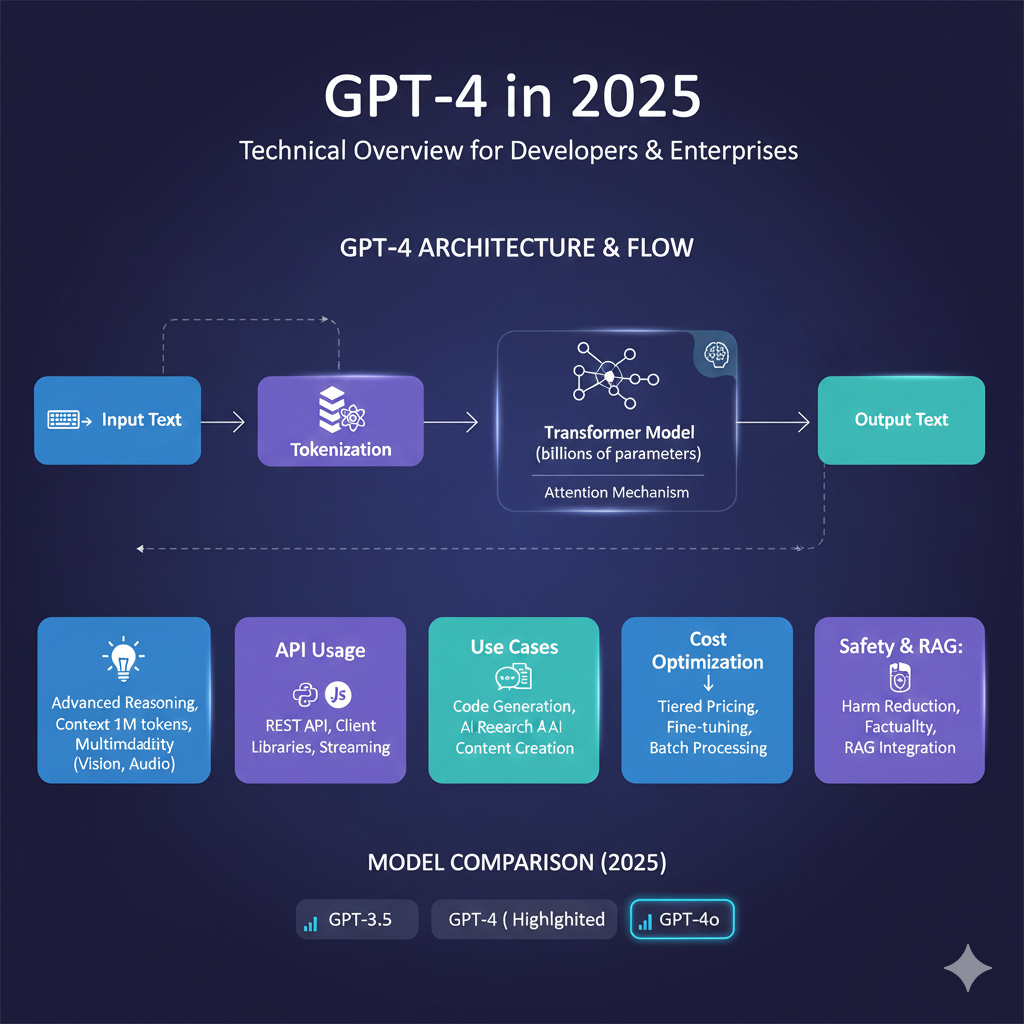
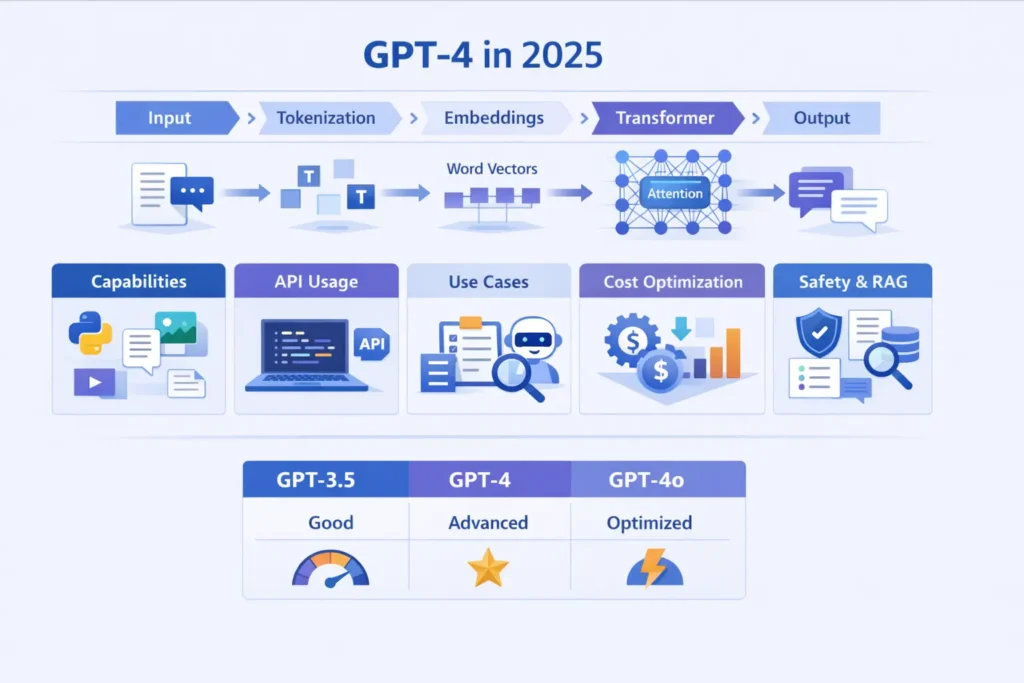
- Tokenization — Input text is split into subtokens (often byte-pair or unigram subwords). Each token maps to an integer id.
- Embedding — Tokens are converted into continuous vectors in an embedding space. For multimodal inputs, image patches are converted into visual embeddings that share or align with the text embedding space.
- Transformer with attention — The core stack uses self-attention and feed-forward networks to compute contextualized representations for each token position.
- Language modeling head — The decoder head maps representations to next-token logits, and the model samples or decodes the next sequence.
- Instruction/alignment layer — After pretraining, supervised fine-tuning and RLHF are used to teach the model desired behaviors and safety constraints.
- Context window/memory — The transformer conditions on a fixed or extended context window (recent variants support very large contexts measured in thousands to millions of tokens).
Important practical limits
- Hallucination: probabilistic models may fabricate plausible-sounding but incorrect tokens. Grounding (via retrieval or strong validators) is essential for factual tasks.
- Context limits: token window size bounds the amount of history or documents you can feed directly. Use retrieval/summary strategies for longer contexts.
- Data freshness: the model’s pretraining cutoff determines the latest internal knowledge; retrieval from current sources is necessary for freshness.
Real-World Capabilities & Benchmarks — What GPT-4 is Good at
Strengths
- Coherent long-form generation: Fluent multi-paragraph text with reasonable discourse structure.
- Code generation & reasoning: Structured outputs, pseudo-code, and sometimes correct program semantics.
- Few-shot and in-context learning: Models can learn task format from a few examples in the prompt without parameter updates.
- Multimodal understanding: Vision-capable variants can parse diagrams, screenshots, and images for structured output.
Common Practical Use Cases
- Semantic search & RAG: Embedding-based retrieval + LLM generation for grounded answers.
- Summarization & condensing: Abstractive summaries and extractive highlights.
- Entity extraction and schema mapping: Converting unstructured text and images to structured data.
- Dialogue systems & assistants: Context-aware, multi-turn conversations with persona or system prompts.
- Coding copilots: Refactor suggestions, tests, and explanations.
Benchmarks that Matter
- MMLU / professional test suites: Measure general knowledge & reasoning.
- Duty-specific poem: kill for classification, F1 for extraction, ROUGE/BLEU for summarization/reading.
- Ready diagnostics: Trip frequency, factuality precision, latency, cost per amount 1k tokens.
Model variants & how to choose
Variant Buckets Minded Taxonomy
- Full capability models: Highest reasoning, used for high-stakes tasks and deep reasoning.
- Chat-optimized / GPT-4o / GPT-4o mini: Tuned for conversational throughput — lower latency and cost.
- Mini / Nano: Parameter- and compute-efficient variants for metadata extraction, classification, or embedding tasks.
- Vision-enabled (GPT-4V): Accepts images; useful for diagram parsing, OCR-adjacent tasks, and screenshot understanding.
How to pick
- High-stakes factual outputs (legal, medical): Full model + RAG + human sign-off.
- High-volume chat or triage: Chat-optimized variants for initial responses; escalate to full models when needed.
- Document pipelines / OCR + parsing: Vision-enabled variant with deterministic validators (regex, numeric checks).
- Low-cost extraction tasks: Mini models or embedding-only pipelines for similarity and intent classification.
GPT-4 Token, Embedding & Retrieval Practicalities
Token accounting
- Estimate tokens: Roughly 3–4 characters per token in Latin scripts; non-Latin or emoji vary.
- Compute cost per request: Cost ∝ (input_tokens + output_tokens). Track token usage per endpoint for accurate billing
Embeddings & Semantic Vectors
- Use Bury models to map documents and queries into a vector space.
- Use close nearest neighbor (ANN) indexes (FAISS, Annoy, HNSW) for scalable improvement.
- For RAG, you often:
- Chunk documents into manageable token-sized pieces.
- Compute embeddings and index them.
- Retrieve top-K passages for a query and include them in the prompt with citations or context.
Designing chunk size
- Chunk size tradeoffs: Smaller chunks improve recall for specific facts but increase retrieval count and cost; larger chunks reduce index size but may dilute relevance.
- Keep chunk size aligned to token limits — e.g., 500–1,000 tokens per chunk for long documents.
GPT-4 Cost & Performance Playbook
Key principle: Route workload to the least-expensive model that meets quality requirements.
Practical strategies
- Hybrid routing: Cheap model for classification/triage → expensive model for generation or complex reasoning.
- Batching: Combine many small inference requests into a single multi-prompt call where possible.
- Caching & memoization: Cache deterministic outputs such as standard replies, outlines, or canonical summaries.
- Token controls: Set max_tokens to reasonable values; use low temperature for deterministic tasks.
- Pre- and post-filtering: Flag low-confidence or hallucinated outputs for secondary verification.
GPT-4 Safety, Compliance & Best Practices
- RAG & provenance: Require the model to cite retrieval IDs and include verbatim excerpts when facts are used.
- Temperature & sampling: Lower temperature for factual tasks; higher for creative drafting.
- PII handling: Redact or token-hash sensitive fields before sending to external APIs unless contractually allowed.
- Erosion &check trails: Store, model versions, retrieval text, and selected outputs for adjustment and compliance.
- Personal -in-the-loop: Require approvals for medium/high-risk outputs.
- Monitoring: Track hallucination rate, response latency, token ma, and management feedback signals
Regulatory notes
- Respect GDPR/HIPAA obligations: for regulated data, prefer enterprise or private deployment options and ensure data processing agreements are in place.
GPT-4 vs Other Models
| Feature / Model | GPT-3.5 | GPT-4 (full) | GPT-4.1 / GPT-4o | Mini / Nano |
| Reasoning & benchmarks | Good | Best | Near full for chat | Limited |
| Multimodal (vision) | No | Yes (variants) | Yes (many) | Limited |
| Cost | Low | High | Medium | Low |
| Best use | Simple chat | High-stakes & multimodal | High-volume chat | Bulk low-cost tasks |
Pros & Cons GPT-4
Pros
- Strong reasoning and instruction following.
- Multimodal options for vision + text tasks.
- Flexible variants to balance cost vs performance.
- Mature tools and many integrations.
Cons
- Hallucinations — requires grounding.
- Costly at scale for full variants.
- Variant naming and availability shift over time — maintain a changelog.
FAQs GPT-4
A: GPT-4 was openly introduced in March 2023.
A: Yes — certain GPT-4 result support multimodal inputs (text + images). Use those variants for task forcing diagrams, screenshots, and photos; combine with OCR and visual embedding pipelines when processing scanned annals.
A: Use cured Augmented Generation (RAG) to ground answers in documents you control, lower sampling climate for deterministic tasks, run deterministic post-validators (regex, numeric checks), and incorporate human review into high-risk discharge.
A: Pricing depends on the provider and alternative. Cost is driven by token consumption and model class. Utilize hybrid routing, grace, and caching to manage expenses effectively. Check your provider’s pricing page for up-to-date debit.
A: Choose by duty needs: full GPT-4 for kill and reasoning; chat-optimized variants for high-volume chat; mini/nano for metadata extraction and classification; vision-enabled for images. Pilot and part
Conclusion GPT-4
GPT-4 is an engineering-grade toolkit: strong at generation, reasoning, and multimodal parsing with the right variant. To use it safely and effectively, pair it with retrieval for factual grounding, use deterministic validators for structured outputs, route requests to cost-appropriate variants, version prompts, and model names, and build audit logging and human reviews for high-risk outputs. The operational success of GPT-4 systems depends less on raw model power and more on the surrounding engineering: token budgeting, retrieval architecture, validation, monitoring, and human workflows.
