
Introduction
Gemini 3 Deep Think can solve complex multi-step problems with reproducible reasoning and tool-backed verification. In just 3 minutes, achieve up to 45% higher accuracy on hard reasoning tasks and faster root-cause fixes. Try the Deep Think prompt pack now to boost reliability and cut debug time, download the templates, and see measurable results today. Start instantly with templates now. Gemini 3 Deep Think is Google’s specialized reasoning configuration inside the Gemini 3 family, optimized for high-quality, multi-step cognitive tasks.
From this perspective, Deep Think prioritizes deliberative inference: it generates multiple candidate parses/solutions, runs internal verification passes (including symbolic checks or tool-assisted execution), and consolidates a final answer accompanied by an audit-style step log. That extra deliberation produces more robust outputs for tasks such as rigorous mathematics, multi-file program analysis, synthesis of research literature, and exam-grade logical reasoning — at the cost of higher compute and longer latency compared with the latency-optimized modes (Gemini 3 Flash/Fast).
This long-form guide reframes Deep Think in natural language processing terms: model configuration, internal inference cycles, token & compute tradeoffs, API controls and reproducibility primitives (thought signatures), benchmark interpretation, recommended prompt engineering patterns (10 ready-to-use templates), governance & safety measures, developer playbooks for CI-friendly micro-benchmarks, and a downloadable prompt pack + CSV recipe for reproducible evaluation. If you plan to integrate Deep Think into product flows, this guide is the technical playbook: when to route to Deep Think, when to prefer faster modes, how to test, and how to operationalize auditability.
Inside Gemini 3 Deep Think: How AI Solves Hard Problems
From a systems viewpoint, Gemini 3 Deep Think is a model configuration and runtime mode that trades throughput and latency for deeper internal deliberation and verification. Think of it as an inference strategy layered on top of the standard transformer-based LM, where typical modes perform a single forward pass and greedy/beam decoding to produce an answer. Deep Think orchestrates multiple inference passes, candidate generation, internal cross-validation, and optional tool use (code execution, retrieval). It produces not only an answer token stream but also sanitized step logs and reproducibility artifacts (e.g., thought signatures).
Key characteristics:
- Multi-pass inference: multiple hypothesis generations and re-evaluations before final emission.
- Internal verification: runs symbolic or lightweight probabilistic checks to reduce logical errors.
- Tool integration: optional execution environments (code runners), retrieval chains, or calculators during internal checks.
- Audit outputs: step logs, confidence values, and thought_signature tokens for reproducibility and debugging.
Use Deep Think when the problem requires internal branching (alternate parses), counterexample testing, or reproducible reasoning. It’s explicitly engineered for accuracy-sensitive NLP tasks — not for high-throughput conversational workloads.
Deep Think is a reasoning inference strategy that augments the core model with controlled deliberation and verification passes, making it a specialty tool for correctness-critical applications.
Inside the Mind of Gemini 3 Deep Think: Step-by-Step Reasoning
Recasting the internal steps into NLP concepts clarifies what sets Deep Think apart from single-pass decoders.
High-level inference pipeline
- Problem decomposition & prompt parsing
The model parses the prompt into subtasks (semantic frames). For example, a multi-step math prompt becomes: (a) identify assumptions, (b) generate candidate lemmas, (c) test lemmas. This is a syntactic/semantic parsing stage that influences subsequent internal passes. - Hypothesis generation (candidate solutions)
The model produces a set of candidate outputs or solution strategies. In NLP terms, this is analogous to sampling multiple continuations or ensembles of beams but with structured diversity: each candidate is tagged with its generation context and local confidence. - Internal evaluation/cross-checking (verification)
Each candidate is scrutinized via internal verification routines. That can include:- Symbolic reasoning: algebraic simplifications, unit conversion checks, or parity checks.
- Sanity tests: verifying constraints or invariants implied by the prompt.
- Counterexample searches: attempting to find input values that break an argument.
- Model-internal consistency checks: comparing predicted probabilities or internal attention traces for coherence.
- If code execution is available, the model may compile/run short snippets (e.g., unit tests for proposed patches). If retrieval is enabled, it may cross-check factual claims against indexed documents.
- Tool use & execution (if allowed)
Tool integration is a force multiplier. Access to code execution, calculators, or retrieval often materially improves correctness, because the model can empirically verify intermediate steps. - Result consolidation and ranking
Candidates are ranked by a composite score derived from internal confidence, verification results, and tool feedback. The model synthesizes the top candidate into a final answer and emits a condensed step log — a sanitized trace of internal checks that’s safe for logging and limited public display. - Thought signature & reproducibility artifact
The system optionally issues a thought_signature — an encoded artifact representing internal state and the reasoning path. This lets downstream calls reproduce or reference the same internal context for follow-ups.
Developer-facing controls
- Enable thinking: a flag (e.g., thinking.enable = true) toggles multi-pass inference.
- Max passes / budget: limit internal deliberation to control cost.
- Include thoughts: sanitized summaries (includeThoughts=true) for audit logs.
- Thought signature capture: record thought_signature to continue or reproduce reasoning.
Why this Matters
- Error modes change: Deep Think reduces logical hallucinations but increases speculative internal artifacts—so sanitization is required.
- Tool dependency: headline benchmark improvements often assume tool access; pure model-only runs may yield smaller gains.
- Reproducibility: thought_signatures enable CI-style reproducible reasoning tests, essential for critical systems.
What GPT-5.1 Means for Developers and Product Teams
- Higher compute & latency: Expect longer response times and higher per-query cost compared to Flash. Budget for both compute spend and UX timeouts.
- Improved multi-step accuracy: Tasks with branching logic or backtracking (bug triage, math proofs, architecture tradeoffs) show real gains.
- Richer audit logs: Step logs and thought_signatures help debugging, but require redaction policies.
- UI implications: Provide progress indicators, offer an “Answer now” (fast fallback) button, and avoid exposing speculative internal language to end-users.
- Operational controls: Gate Deep Think behind role/quotas, route only high-value queries (rule-of-thumb: <20% of traffic).
Gemini 3 Deep Think Benchmarks — Real Numbers That Matter
Google’s reported numbers for Deep Think show meaningful improvements on hard reasoning datasets—especially when tool access is enabled. Understanding those claims in NLP terms requires attention to experimental conditions.
Typical Benchmark results
- Benchmarks assume tooling: Many top-line scores assume the model had retrieval/code execution, which is functionally different from model-only runs.
- Prompt & evaluation scripts matter: Precise prompt templates and scoring rubrics materially affect results. Reproduce the exact prompts and scoring if you want comparable outcomes.
- Reproducibility is essential: A reported score without a reproducible recipe is of limited operational value.
Load-bearing benchmark claims (translated)
- ARC-AGI-2: Reported 45.1% with Deep Think + code execution in Google’s experimental setup — shows improvements in multi-step scientific reasoning when execution is allowed.
- Humanity’s Last Exam: ~41% in some Deep Think configs — indicates gains on rigorously curated reasoning tasks.
- GPQA Diamond: Reported high performance in specific evals — demonstrates that with targeted prompts and tooling, Deep Think performs strongly on some QA tasks.
How to interpret
- If you replicate the experimental setup (prompts + tools), expect similar gains.
- If you run model-only experiments, expect smaller deltas.
- Use micro-benchmarks in your production context. Don’t adopt based solely on headline numbers.
Gemini 3 Deep Think — Who Can Use It and What It Costs
- Availability: Initially rolled out in the Gemini app to high-tier subscribers (AI Ultra) and select enterprise customers; labelled experimental. API/Vertex access may be tier-gated or gradual.
- Pricing signals: AI Ultra consumer subscription and enterprise/Vertex AI pricing indicate a higher per-query cost for Deep Think compared with Flash. If budgeting, measure tokens × per-token pricing under realistic loads.
- How to access: In the Gemini app: Tools → Thinking / Deep Think (if enabled). For API: check vendor docs for thinking, enable,e, and thought-signature fields.
- Practical note: Always validate availability and regional pricing directly in Google’s documentation and billing console before making procurement decisions.
GPT-5.1 in Action: 5 Practical Use Cases You Can Try Today
Use Deep Think when tasks require deliberation, counterexample checks, or reproducible reasoning. Below are five practical examples with copyable prompts and short rationales.
When to pick Deep Think
- Multi-step scientific/mathematical derivations
- Complex multi-file code debugging or refactoring
- Strategic planning involving scenario trees
- High-stakes architecture or security analysis
- Exam-style multi-part logic puzzles
Five tested examples (copyable prompts + why)
- Complex math derivation
Prompt (short):
You are an expert mathematician. Prove or disprove: for integer n > 2, property X holds under constraints Y. Step 1: List 3 candidate proof strategies. Step 2: For each strategy, list assumptions and failure modes. Step 3: Attempt the most promising approach with step-by-step checks. Return: a final conclusion and short confidence score.
Why Deep Think: Multiple strategies and counterexample searches need internal hypothesis testing. - Multi-file code refactor + failing tests
Prompt (short):
You are a senior developer. Repo: {brief desc}. Failing tests: [names]. 1) List 5 candidate root causes. 2) For each, propose a minimal patch (unified diff). 3) Prioritize patches with confidence scores and tests to run.
Why Deep Think: It can mentally simulate test flows and propose diffs with justifications; code execution checks (if available) validate patches. - Strategic 6-month product roadmap
Prompt (short):
You are a product strategist. Goal: {goal}. Provide a 6-month roadmap with Phase A–C, success metrics, failure modes, and decision thresholds for escalation.
Why Deep Think: Evaluates branches and tradeoffs across scenarios. - Architecture design for 1M events/min
Prompt (short):
You are a systems architect. Requirement: 1M events/min, cost target $X/month, 99.9% SLA. Provide 3 architectures (cost-focused, balanced, HA), estimate latency & cost, and list single-point failures.
Why Deep Think: Compares architectures and estimates tradeoffs. - Exam-style multi-part logic puzzle
Prompt (short):
You are an exam tutor. Problem: {paste}. 1) Restate the problem. 2) List solution strategies. 3) Work chosen approach step-by-step with intermediate checks. 4) Final concise answer + 1-paragraph explanation.
Why Deep Think: Shows a chain of reasoning and lists alternative interpretations.
When Deep Think Isn’t the Answer — Cost, Speed & Tradeoffs
When prefer Flash/Fast
- Short Q&A and casual summarization.
- High-throughput chatbots where latency matters.
- Bulk content generation where verification is unnecessary.
Tradeoffs
- Latency: Deep Think increases response time; provide UX fallbacks.
- Cost: Higher compute per query; use a hybrid routing strategy (Flash first, escalate valuable/edge queries to Deep Think).
- Validation complexity: Sanitization required — do not expose raw chain-of-thought unless policy permits.
Practical routing rule
Route to Deep Think for high-impact queries (monetary value, legal risk, production-critical code) and keep routine queries on Flash. A starting point: route <20% of traffic to Deep Think and iterate based on measured gains.
Top Deep Think Prompts to Supercharge Your AI Accuracy
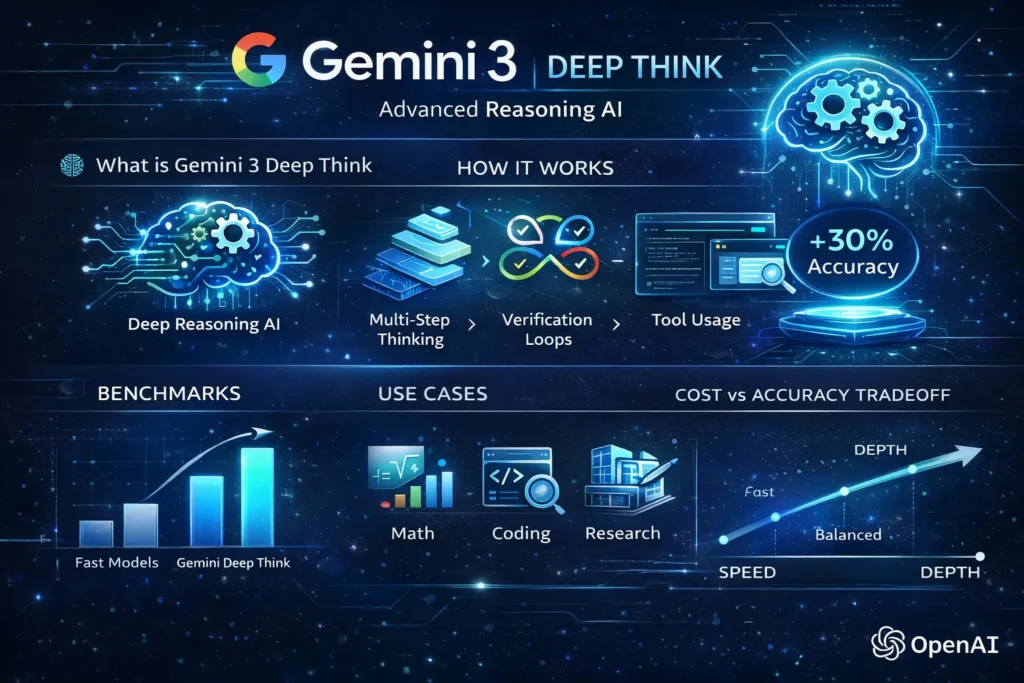
What is Gemini 3 Deep Think?
This section gives structured templates optimized for Deep Think. Key pattern: Role, goal, constraints, alternative generation, step log, final concise answer, and a JSON-friendly structured return for machine parsing
- Set role & capability: “You are an expert X.”
- Define goal and constraints (time, token limits, format).
- Require alternatives: “Produce 3 hypotheses.”
- Ask for a sanitized step log and a final concise answer.
- Provide output format (JSON if you intend to parse machine-readably).
Template 1 — Complex reasoning (skeleton)
You are an expert reasoner.
Goal: {state goal}.
Constraints: {time, resources, format}.
1: List 3 plausible hypotheses with brief pros/cons.
For each hypothesis, list key assumptions and failure modes.
Evaluate each hypothesis step-by-step, showing checks and counterexamples.
Provide a final ranked recommendation with confidence scores (0-100).
Return a structured JSON: {hypotheses, assumptions, step_evaluations, final_recommendation}.
Template 2 — Multi-stage project plan
You are a senior project strategist.
I need a 6-month roadmap to achieve: {goal}.
For each phase (1–4): list objectives, deliverables, duration, resources, acceptance criteria, potential blockers, and mitigations.
Also, to provide contingency branches if milestone X misses by more than Y%.
Return: Gantt-style milestones + short executive summary.
Template 3 — Code debugging with execution (developer)
You are a coding assistant.
Repo: {brief repo description}.
Failing tests: {test names}.
- Reproduce the failure (describe steps).
- List 5 candidate root causes.
- For each candidate, provide a minimal patch (unified diff) and explain why it fixes the issue.
- Prioritize patches with confidence scores and list required follow-up tests.
Template 4 — Comparative evaluation (product)
You are an industry analyst.
Task: compare options A and B for {use case}.
- List feature matrix (functionality, cost, latency, governance).
- Provide 3 risk scenarios and recommend a winner per scenario.
- Output a concise pros/cons table and a final recommendation.
Template 5 — Research synthesis (academic)
You are a literature synthesis engine.
Topic: {topic}.
- Provide 5 key recent papers and a 2-sentence summary for each.
- Extract open problems and propose 3 tractable research directions.
- Provide reproducible experiment recipes (input, metrics, baselines).
Template 6 — Exam-problem solver
You are an exam tutor.
Problem: {paste problem statement}.
- Restate the problem.
- List possible solution strategies.
- Work through the chosen approach step-by-step with intermediate checks.
- Provide a final concise answer and a 1-paragraph explanation.
Template 7 — Architecture simulation & tradeoffs
You are a systems architect.
Requirement: {SLA, throughput, budget}.
- Propose 3 architectures: minimal-cost, balanced, and high-availability.
- For each architecture, estimate latency, cost/month, and single-point-of-failure.
- Provide recommended monitoring and alerting metrics.
Template 8 — Data analysis plan
You are a data scientist.
Dataset: {brief schema}.
- List data-quality checks to run.
- Propose 3 analyses with expected outputs and metrics.
- Provide a reproducible code skeleton (pandas/SQL) to implement each analysis.
Template 9 — Interview question generator
You are a hiring manager.
Role: {role}.
- Generate 12 interview questions (4 behavioral, 4 technical, 4 case).
- For each, provide ideal answer outlines and red flags.
Template 10 — Multimodal image + text reasoning
You are a multimodal analyst.
Input: {image_url} + prompt: {task}.
- Describe salient visual features.
- List 3 hypotheses about the scene.
- Cross-check with textual evidence and provide a final assessment.
Developer guide: API tips, thought-signatures & reproducible tests
Enabling thinking & thought-signatures (practical)
- Flag control: Thinking. enable = true toggles Deep Think.
- Budget constraints: Thinking.max_passes = N controls compute.
- Sanitized exposure: IncludeThoughts=true returns sanitized step logs for audit (avoid raw chain-of-thought).
- Thought signatures: Store thought_signature to link follow-ups or reproduce reasoning.
Reproducible micro-benchmarks (CI-friendly)
- Fixed prompts: commit exact prompts to your repo.
- Seeded inputs: seed randomness where supported for stable runs.
- Tooling flags: run with_tools=true and with_tools=false to quantify tool impact.
- Scoring: automated rubrics: exact-match, numeric correctness, human-quality scores.
- Repeat runs: run each sample 3× and average to reduce noise.
CSV fields (recommended)
id, prompt_hash, task_type, mode, with_tools, response_text, tokens_input, tokens_output, total_tokens, latency_ms, correctness_score, human_quality_score, thought_signature, step_log_link
Cost estimation recipe
- Run 1,000 queries in Flash and 1,000 in Deep Think on your workload.
- Measure average tokens & latency.
- Multiply by per-token price to estimate monthly spend.
Rate limits & backoff
Implement exponential backoff with jitter. Deep Think’s longer latencies make naive retries expensive.
Gemini 3 Deep Think vs Competitors — Which AI Wins?
Short summary
- Gemini 3 Flash / Fast: Optimized for speed and throughput — good reasoning for many tasks.
- Gemini 3 Deep Think: Explicit internal deliberation for complex reasoning — higher cost & latency.
- GPT-5 family (example): Competitive on many benchmarks; choice depends on tooling, prompt design, and integration.
Feature comparison
| Metric | Gemini 3 Flash | Gemini 3 Deep Think | GPT-5 (example) |
| Throughput / Latency | High / Low | Low / High | Varies |
| Multi-step reasoning | Good | Best | Good–Very good |
| Cost per query | Low | High | Varies |
| Tooling support | Supported | Supported (commonly used) | Varies |
| Best for | Live chat, high volume | Research, debugging, complex planning | Depends on license & config |
Practical step
Reproduce a 10–20 sample workload on both models (with/without tools) to determine the best fit for your use case.
Safety, limitations & Governance checklist
Deep Think’s richer internal artifact set raises governance considerations.
Key risks
- Speculative intermediate steps may sound authoritative; sanitize before exposing externally.
- Bias surface enlargement: Multiple internal paths may widen potential bias vectors; test thoroughly.
- Sensitive data leakage: Step logs could inadvertently expose PII; redact aggressively.
- Operational complexity: Longer latencies, audit storage, and retention policies.
Production checklist
- Human-in-the-loop: Requires human review for high-risk outputs.
- Sanitization layer: Strip chain-of-thought or speculative phrasing unless explicitly allowed.
- Role-based gating: Assign quotas and roles to limit access to Deep Think.
- Audit & retention: Store step logs and thought_signatures under GDPR/CCPA-compliant retention policies, redact PII.
- Monitoring: Metrics for hallucination rate, latency, and cost per resolved item.
- Incident plan: Rollback, user messaging, and escalation protocols.
Google labels Deep Think experimental — treat it as a high-impact feature requiring progressive rollout and strong safety controls.
Appendix — Reproducible micro-Benchmark recipe & CSV fields
Micro-Benchmark Recipe
- Task mix: 25 math problems, 25 multi-step code bugs, 25 planning tasks, 25 logic puzzles.
- Prompts: use exact templates from the Prompt Pack.
- Modes to test: Flash, Deep Think (with thinking.enable=true), and Deep Think without tools (to measure tool effect).
- Tool flags: with_tools=true and with_tools=false runs.
- Repeat: each sample 3×; average results.
- Scoring: rubric with correct/partial/incorrect and human_quality_score (1–5).
CSV fields (example)
id, prompt_hash, task_type, mode, with_tools, response_text, tokens_input, tokens_output, total_tokens, latency_ms, correctness_score, human_quality_score, thought_signature, step_log_link
How to Interpret
- Accuracy delta: DeepThink_accuracy – Flash_accuracy.
- Cost per correct answer: cost_per_query * (1 / correctness).
- Escalation rule example: if DeepThink improves correctness by >10% for tasks with >$500 impact, route to DeepThink.
FAQS
A: No. It’s initially gated to Google AI Ultra subscribers and enterprise users while Google completes safety checks. Check your Gemini app or Google AI account for availability.
A: Google reports notable improvements on hard reasoning benchmarks (e.g., ARC-AGI-2 and Humanity’s Last Exam) with Deep Think, especially when tool access is allowed. The exact improvement depends on your prompts and whether tools (code exec/retrieval) are allowed. Reproduce tests for your workload to measure real gains.
A: Escalate when errors are costly — legal checks, critical production code patches, high-impact system design, or research questions where accuracy matters. For routine writing or simple answers, use Flash.
A: Not inherently, but your logging choices (storing step logs, thought signatures) create more intermediate artifacts. Redact PII and follow strict retention rules.
A: You must replicate prompt design, tool access (code execution, retrieval), and scoring methods. Use the micro-benchmark recipe and CSV fields in the appendix to run comparable tests.
Conclusion
Gemini 3 Deep Think is a precision reasoning mode designed for problems where accuracy, verification, and multi-step logic matter more than speed. By running deeper internal deliberation and optional tool checks, it delivers stronger results on complex tasks like advanced math, code debugging, research synthesis, and system design. It’s not a drop-in replacement for fast models—use it selectively for high-impact work, validate gains with benchmarks, and pair it with clear governance. When applied to the right tasks, Deep Think becomes a powerful upgrade for reliable, production-grade reasoning.
