

Introduction
GPT-4.5 is a 2026 research-preview family of transformer-based autoregressive chat models from OpenAI that emphasizes polished natural language generation (NLG), improved pattern recognition on multimodal inputs, and a reduced incidence of factual errors (hallucinations) in many public evaluations. Practically: use it for creative NLG, dialogue agents, and general-purpose code generation with unit tests. For tasks requiring deep, formal stepwise reasoning (long proofs, formal verification), prefer a reasoning-specialist model or architectures that expose chain-of-thought traces. In production, instrument reproducible benchmarks (automatic metrics + human annotations), decouple model endpoints behind an adapter layer, and design cheap, robust fallbacks.
Why You Need This GPT-4.5 Guide Now
You’re reading this because you want a single, replicable, and methodical guide for deciding whether a model in the GPT-4.5 family belongs in your stack. This document reframes product, engineering, and research questions in NLP-centric language so you can:
- Understand what GPT-4.5 optimizes for (fluency, style transfer, pattern recognition, calibrated confidences).
- See how to measure it on closed-book datasets, open-ended generation tasks, and human-judged metrics.
- Copy reproducible benchmark code, instrumentation, and CSV schemas to publish.
- Make deployment and migration decisions while explicitly accounting for lifecycle risks (preview snapshots can be deprecated).
What Makes GPT-4.5 Different in 2026
At an abstract level, GPT-4.5 is an autoregressive transformer variant trained with large-scale unsupervised pretraining and supervised and RL-based fine-tuning (policy updates and alignment tuning). Key operational characteristics:
- Decoding behaviour: Tuned to produce coherent text with fewer low-probability lexical leaps; decoding defaults emphasize lower temperature and nucleus sampling for constrained outputs but can be configured for higher creativity.
- Representation quality: Embeddings and internal activations show improved separability for certain multimodal alignment tasks (text+image token fusion), helping downstream classification or grounding.
- Calibration & confidence: Model outputs more conservative calibration on many public tests — probability estimates (or proxy “confidence” signals) better correlate with factuality than earlier general-purpose chat models in independent trend analyses.
- No guarantee of transparent chain-of-thought: By default, GPT-4.5 returns concise answers rather than exposing lengthy internal reasoning sequences — it was optimized for succinct, user-ready outputs rather than raw introspective traces.
- Preview lifecycle risk: Some snapshots (e.g., gpt-4.5-preview) are experimental and have scheduled deprecation windows — plan to isolate such variants in your stack.
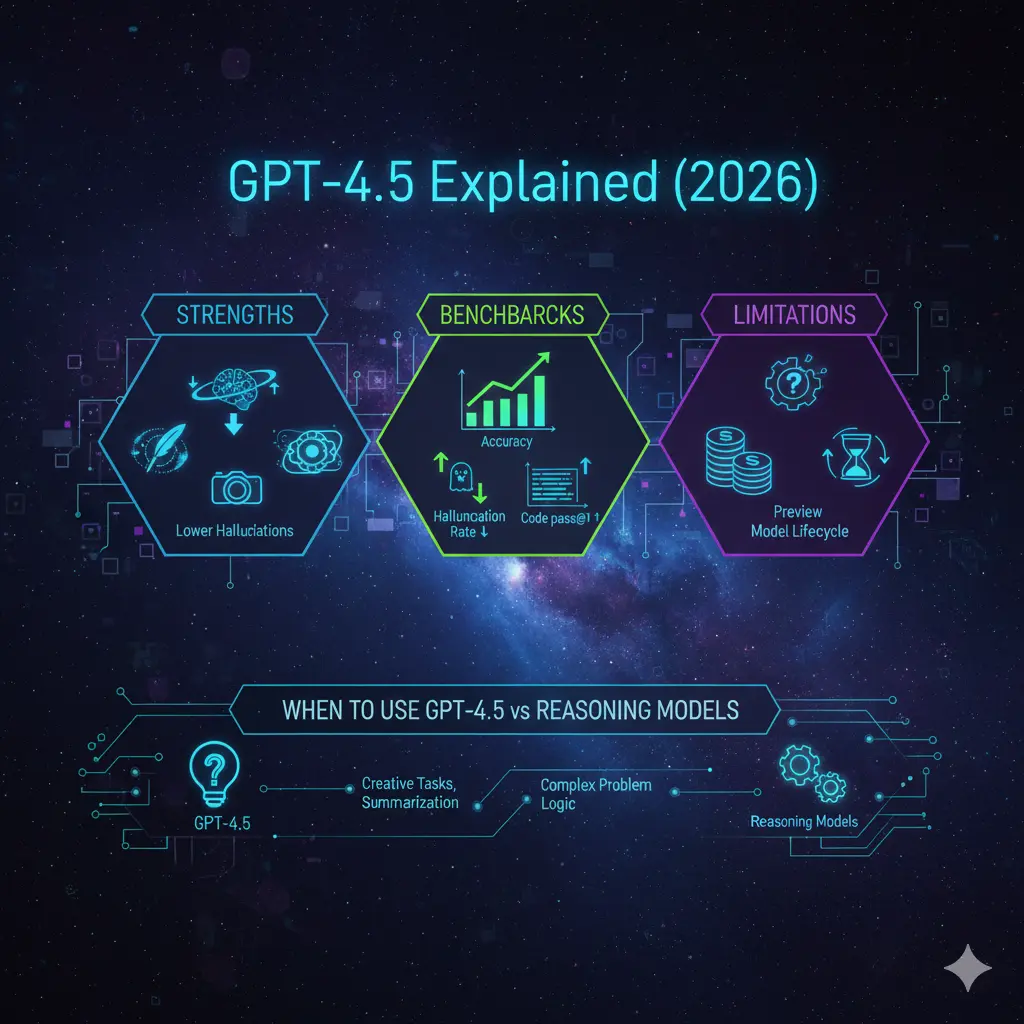
GPT-4.5: Strengths, Limits, and What to Watch
Strengths
- Surface-level coherence & style adaptation: Excellent at generating marketing copy, dialogue turns, and controlled stylistic transfers (formal → casual).
- Multimodal pattern recognition: Better at extracting structured information from short documents and images when image/text ingestion is enabled.
- Lower measured hallucination: Many independent test suites report fewer fabrications on closed factual QA relative to some previous chat models.
- Human-like conversational grounding: Effective for assistant-style use cases with persona and context-preservation.
Limitations
- Deep symbolic/stepwise reasoning: Models specialized for chain-of-thought remain preferable when formal stepwise proof is needed.
- Cost & throughput: Larger compute per token; consider tradeoffs when throughput or cost-per-request is a priority.
- Preview coupling risk: Do not hard-code preview snapshot endpoints in critical workflows.
Why Reproducible Benchmarks Are Crucial for GPT-4.5
Benchmarks are only useful when replicable. Differences in tokenization, prompt templates, sampling seeds, and evaluation scripts can yield divergent claims. For meaningful decisions:
- Use closed-book question sets with ground truth for exact-recall tests.
- Use open-ended generation datasets with human evaluation buckets (usefulness, safety, factuality).
- Record random seeds, tokenizer versions, prompt templates, sampling parameters (temperature, top-p, top-k, beam width).
- Publish raw model outputs, rater guidelines, and aggregated human judgements.
Why the Above Matters:
pretraining corpora, fine-tuning curricula, and prompt variance can drastically alter hallucination rates and apparent accuracy.
GPT-4.5: Key Benchmark Categories You Can’t Ignore
- Factual QA / Closed-book knowledge
- Metric: exact-match accuracy, F1.
- Datasets: NaturalQuestions, curated domain-specific FAQs.
- Hallucination & safe-answering
- Metric: hallucination rate (binary + severity).
- Protocol: include out-of-domain or adversarial queries; enforce “I don’t know” policy for uncertain answers.
- Code generation
- Metric: pass@k (unit-test-based), syntactic error rate.
- Protocol: run generated code in sandboxed unit tests (HumanEval-like).
- Reasoning / Multi-hop
- Metric: stepwise correctness, final answer accuracy.
- Protocol: include chain-of-thought prompts and evaluate whether intermediate steps are correct.
- Real-world user tasks
- Metric: human usefulness rating (1–5), time-to-complete.
- Protocol: sample real user queries, blind A/B test vs baseline.
- Latency & Cost
- Metric: ms/token, tokens/sec, $/1k tokens consumed.
- Protocol: measure under production-like batching and concurrency.
Sample Evaluation Checklist for Reliable Testing GPT-4.5:
- Freeze tokenizer and model snapshot names.
- Use reproducible seeds and deterministic sampling where possible.
- Publish notebooks and raw CSVs to GitHub or a reproducible artifact store.
- Keep human rater instructions fixed and publish them with results.
- Use multi-rater majority vote for binary labels; report inter-rater agreement (Cohen’s kappa or Fleiss’ kappa).
Sample Benchmark Table for Real-World Insights GPT-4.5:
| Task | Metric | GPT-4 | GPT-4.5 (example) | Notes |
| Simple factual QA | Accuracy (%) | 78.2 | 84.1 | closed-book auto-eval |
| Hallucination tests | Halluc rate (%) | 61.8 | 37.1 | lower fabrications on many public tests |
| Coding (HumanEval) | pass@1 (%) | 64.0 | 68.5 | run 100 samples w/ unit tests |
| Chain-of-thought math | Accuracy (%) | 72.0 | 65.0 | reasoning-specialist wins |
| Latency | ms/token | 18 | 20 | example: infra dependent |
Avoiding GPT-4.5 Mistakes: Factuality Checks You Must Do
Definition (operational): Hallucination rate = fraction of responses containing one or more factual errors relative to the ground truth judge label.
Design a Robust Hallucination Evaluation:
- Use closed-book queries with objective ground truth.
- Force an uncertainty-safe policy: instruct the model to output an explicit “I don’t know” when confidence < threshold.
- Collect severity labels for errors: minor drift vs. complete fabrication.
- Use 3+ human raters and compute the majority label; report inter-rater agreement.
Mitigations:
- Constrained decoding: Reduce temperature or use top-p/top-k to minimize improbable tokens.
- Answer-verification loop: Run an internal consistency check (e.g., verify named entities or numerical facts against a knowledge base).
- Retrieval augmentation: Hybrid retrieval-augmented generation (RAG) — fetch documents and condition outputs explicitly on retrieved text with citation snippets.
- Calibrated abstention: Implement a policy where the model must abstain if the retrieval confidence is low.
GPT-4.5 vs GPT-4 / Reasoning Models Decision Matrix
| Use case | Prefer GPT-4.5 | Prefer GPT-4 / reasoning-specialist |
| Marketing copy, storytelling | ✅ | ❌ |
| Short-to-medium code generation | ✅ | ❌ |
| Customer-facing conversations | ✅ | ❌ |
| Formal proofs, long math reasoning | ❌ | ✅ |
| Ultra-low-cost trivial tasks | ❌ | ✅ (smaller models) |
Why: GPT-4.5 optimizes for fluent, pragmatic outputs; reasoning-specialist models are architected and trained for explicit multi-step symbolic reasoning.
GPT-4.5: Access, Costs, and Model Lifecycle Explained
Availability: GPT-4.5 launched as a preview family; early access rolled out to paid developer/pro tiers and some managed partners.
Pricing & Compute Tradeoffs:
- Expect higher inference cost per token compared to smaller families.
- Measure cost using a formulaic approach (see Section 12).
Lifecycle Note:
Preview snapshots (e.g., gpt-4.5-preview) can be deprecated. If you rely on preview endpoints, prepare migration tooling and automated tests to validate model switches.
GPT-4.5: Calculating Cost vs Performance Effectively
Monthly Cost Formula:
Monthly cost = (Avg_tokens_per_request * requests_per_month / 1000) * price_per_1k_tokens + fixed_subscription + infra_costs
Worked Example:
- Avg tokens (in+out) = 1,200
- Requests/month = 50,000
- Price per 1k tokens = $0.12
- Subscription fee = $200
Token bill = (1,200 * 50,000 / 1,000) * $0.12 = 60,000 * $0.12 = $7,200
Total ≈ $7,400/month
Recommendations:
- Cache deterministic responses.
- Use smaller models for cheap or short tasks.
- Batch inputs if your latency constraints allow.
- Monitor cost per conversion (business metric).
GPT-4.5: How to Build a Reproducible Benchmark That Works
- Assemble gold datasets: 10–100 high-quality examples per critical flow.
- Define metrics: automated (accuracy, pass@1) and human (usefulness 1–5).
- Standardize prompt templates: freeze system and user messages.
- Deterministic runs: use seeds; record sampling parameters.
- Human evals: run blind A/B tests (randomize order, de-identify model tags).
- Failure corpus: save and tag the top 100 worst outputs for analysis.
- Pilot & iterate: small HITL pilot before full rollout.
- Publish artifacts: CSVs, notebooks, and rater instructions.
Migration and Deployment Tips You Can’t Ignore
- Do not swap blindly. Stage rollouts and run A/B tests.
- Stagger releases. Start with non-critical flows (marketing drafts).
- HITL for high-risk flows. Legal and medical outputs should have mandatory human checks.
- Adapter layer pattern: create an abstraction that normalizes output schemas, confidence fields, and tokenization differences. This enables model switching with minimal upstream changes.
- Automated regression tests: run end-to-end tests after any model switch.
- Fallbacks: embed a policy to route low-confidence or high-risk queries to a more conservative baseline.
GPT-4.5 in Action
Marketing Brief Generation
System: You are a senior marketing strategist. Provide a 2-week campaign brief for a B2B SaaS product targeting mid-market HR teams.
User: [product details]
Why it works: GPT-4.5’s tone adaptation and clarity produce usable drafts that require light edits rather than full rewrites.
Case study: Code Generation & Review
- Use pass@1 and unit tests; always run the generated code inside CI.
- Save failing cases and tag whether failure is syntax, logic, or a missing edge-case.
Protecting Data with GPT-4.5: Security and Compliance Tips
- Run domain-specific red-team tests (PII handling, privacy leakage).
- For regulated domains (medical/legal), require HITL and explicit “do not rely solely” disclaimers.
- Keep logs and an incident response process for when the model fabricates or exposes sensitive content.
- Use system cards and safety docs as a baseline, but add domain-specific controls.
GPT-4.5 Features and How to Use Them Effectively
| Feature | GPT-4.5 | GPT-4 (stable) | Recommendation |
| Creative writing | Excellent | Good | Use GPT-4.5 for drafts & ideation |
| Chain-of-thought math | Fair | Better (reasoning model) | Use Specialized reasoning models |
| Code generation | Very Good | Good | Use with unit tests/CI |
| Hallucination measured | Lower on many tests | Higher | Always validate domain data |
| Cost (inference) | Higher | Variable | Budget & test costs first. |
Pros & Cons
Pros
- Strong creative & conversational generation.
- Lower hallucinations on many public tests.
- Better for multi-modal workflows when file & image ingestion is available.
Cons
- Not a substitute for reasoning-specialist models in formal proofs.
- Higher compute cost and access tiering.
- Preview API lifecycle requires migration planning.
FAQs
A: It depends. GPT-4.5 improves creative fluency and often shows lower hallucination rates on public tests. But for stepwise formal proofs, reasoning-specialist models can still be better. Test on your data.
A: Preview variants were available to developers, but preview snapshots (like gpt-4.5-preview) have deprecation schedules. Avoid hard-coupling to preview endpoints for critical services; plan for fallbacks.
A: No. GPT-4.5 is strong for conversational and creative tasks, but reasoning-specialist models still outperform on formal multi-step problems.
A: Use closed-book QA with ground truth, require “I don’t know” for uncertainty, and use multi-rater human evaluation (3+ raters). Publish scripts and CSV files so that others can reproduce your work.
Final verdict
GPT-4.5 is a pragmatic, production-relevant family for many teams. It delivers cleaner creative outputs, improved multimodal pattern recognition, and measurable reductions in hallucination on many public evaluations. However, it is not a universal replacement for reasoning-specialist models. Treat GPT-4.5 as a powerful tool in your architecture — abstract model endpoints, run reproducible tests, and maintain migration plans.
