

Introduction
In 2025, generative systems for pixels and frames are best understood through the same conceptual lenses we use for natural language models: tokenization → embeddings → conditioning → sampling → fine-tuning → deployment. If you work with creative systems—designers, product managers, marketers, game developers, or ML-savvy creatives—understanding Leonardo AI through NLP metaphors helps you reason about reliability, reproducibility, cost, and integration.
In this rewired, NLP-centric review, aloneperson, I treat Leonardo AI as a multimodal generative stack and translate its features into terms familiar to people who design and productionize language models. You’ll learn: the model families and conditioning strategies Leonardo exposes, how its “token” economy maps to compute and API quotas, what “custom model training” really means (in ML terms), how video/motion generation imposes temporal coherence constraints, and when the platform is a good architectural fit for your workflow.
Quick Verdict — Who Should Use Leonardo AI
Suppose you want a production-ready multimodal generator with explicit support for brand-level fine-tuning, API-first integration, and short-form motion conditioning. In that case, Leonardo AI is a compelling engineering and product choice.
| Who it’s for | Who it’s not for |
| Creators, marketers, small teams needing image + video generation + brand consistency | Those who prioritize the largest social/plugin ecosystem or extreme fine-art experimentation |
| Brands wanting custom model training & style anchors | Hobby users seeking toy filters and casual effects |
| Teams needing API access, tokenized quotas, and controlled permissioning | Users who only want one-off images with no need to scale |
“What is Leonardo AI?”
High-level analogy: Leonardo AI is a multimodal inference and fine-tuning platform that provides pretrained generative backbones (image and video diffusion & transformer hybrids), a prompt-to-embedding pipeline, a model selection layer (variants optimized for photorealism vs stylized output), and a managed fine-tuning service that produces “specialized checkpoints” for brand-specific distributions.
Key NLP analogies:
- Prompt → Tokenization → Embedding: In NLP, we tokenize text and map tokens into dense vectors. For image generators, the pipeline is analogous: textual prompts are tokenized by a text encoder (e.g., transformer/CLIP-style encoder), mapped into embeddings, and used as conditioning vectors for a diffusion model or a transformer-decoder that decodes pixels/latents. Understanding this helps you reason about prompt length, specificity, and the effect of added context.
- Conditioning & Cross-attention: Many image/video generators use cross-attention between image latents and text embeddings—this is functionally similar to attention between context tokens and generation tokens in text models. Changing prompt phrasing or using “negative prompts” changes the conditioning vectors and, therefore generation behavior.
- Latent space sampling: Where LLMs sample discrete tokens, diffusion-based image models sample continuous latent states via iterative denoising. Think of it as sampling a trajectory through a latent manifold guided by a learned denoiser conditioned on your prompt embeddings.
- Fine-tuning / Custom model training: Equivalent to fine-tuning an LLM on domain-specific corpora. Leonardo’s branded model training is a managed fine-tuning or adapter-style workflow that adapts weights or adds small conditioning modules so that the generator maps your prompt conditioning to outputs aligned with a brand distribution.
- Videos as sequences: Video generation enforces temporal coherence—equivalent to language models maintaining discourse coherence across sentences. Video models add temporal conditioning, optical flow priors, or recurrent latent techniques so frames are consistent across time.
Key features — interpreted as ML/NLP components
Model Families & Presets → Selector of architectural priors
Leonardo exposes several model families—think of them as different pretrained checkpoints, each biased by training data and objective: “PhotoReal” (high-fidelity photorealism; analogous to a model tuned for factual text), “Lightning XL” (general-purpose multimodal generator; akin to a large general LLM), and cinematic/stylised families (models with priors favoring painterly or cinematic distributions).
Practical implication: choose a checkpoint whose inductive biases match your target distribution rather than attempting to coerce one model into doing everything.
Prompting, Prompt Engineering & Negative Prompts → Conditioning strategy
In NLP, we know that prompt phrasing, few-shot exemplars, and control tokens influence model behavior. For Leonardo:
- Prompt engineering is the primary control surface.
- Negative prompts function like constrained decoding or rejection criteria: they tell the conditioning mechanism what attributes to avoid.
- Seeding and deterministic sampling allow reproducible runs (analogous to fixed random seeds in LLM sampling).
Custom Model Training → Fine-tuning, adapters, and embedding anchors
Leonardo’s custom models are conceptually fine-tuned checkpoints or adapter modules trained on user-provided assets. From an NLP perspective, the process includes:
- Dataset curation (collect images/frames with metadata/prompts).
- Preprocessing & augmentation (standardize resolution, remove outliers).
- Fine-tune checkpoint with regularization (to avoid catastrophic forgetting).
- Validate with held-out (prompts to verify generalization).
Adapters or LoRA-style parameter-efficient fine-tuning reduce compute and risk of overfitting—ideal for brand identity tasks.
API & Team Features → MLOps primitives
An API plus token system gives you programmatic inference, enabling CI/CD for asset generation: automated generation pipelines, scheduled campaigns, or integration with a CMS/E-commerce backend. Team features (permissioning, shared token pools) map to role-based access control you’d expect in MLops.
Video & Motion tools → Temporal models and conditioning windows
Video generation is handled by models that incorporate temporal priors. Practically, this involves either:
- Frame-by-frame diffusion with temporal-consistency loss terms, or
- Spatio-temporal latent diffusion that jointly models sequences.
Both approaches require more compute and tokens—similar to longer-context LLM queries.
Leonardo AI Pricing, Tokens & Tokenomics
Leonardo’s pricing is best interpreted as a compute-credit economy similar to Inference credits for LLM APIs.
- Tokens = compute credits: Each generation consumes credits proportional to model size, resolution, number of diffusion steps, and whether video (temporal frames) is generated. Complex prompts with high-res assets or video sequences cost more.
- Plans = quota + SLA: Free tiers give limited credits suitable for experimentation. Paid tiers offer larger monthly credit pools, priority queues, and access to larger checkpoints (analogous to model families with more parameters).
- Per-asset cost: If you generate many assets, amortize by buying a plan with pooled credits or using on-prem/enterprise arrangements for predictable costs.
Best practice: instrument generation cost per asset (credits / successful output) and optimize prompts & sampling parameters to minimize wasted credits.
Hands-On Testing
When evaluating generative systems, we run controlled A/B experiments. For Leonardo, the tests below treat prompt → embedding → generation as an experiment with metrics approximated from image quality literature (perceptual realism, prompt fidelity, and consistency across runs).
Experimental design notes
- Keep a fixed random seed to measure reproducibility.
- Use explicit prompt templates and vary a single factor per run (e.g., model checkpoint, CFG scale, negative prompt).
- Record metrics: human preference scores, automated perceptual metrics (LPIPS, FID proxies), and prompt adherence (qualitative).
Test 1 — Photorealism (analogy to factual accuracy tests)
Prompt: “Ultra-realistic product photo of a sleek matte-black wireless headphone, studio lighting, 8K, shallow depth of field, white background”
NLP framing: This is a prompt that demands fidelity to object attributes and photographic priors. It’s analogous to factual prompts in NLP where you expect the model to obey hard constraints.
Observations:
- The PhotoReal checkpoint produced outputs with accurate specular highlights, realistic reflections, and consistent DOF—i.e., it captured the photographic prior embedded in its training distribution.
- Artefacts (hands in character work, small texture glitches) were low for this domain—similar to an LLM performing well on in-domain factual completion.
Interpretation: Use dedicated photoreal checkpoints and explicit negative prompts to suppress artful stylization.
Test 2 — Stylised Art (analogy to creative generation)
Prompt: “Fantasy illustration of a half-human, half-dragon sorceress in a lush enchanted forest, vibrant colours, painting style, 4K”
NLP framing: This is a creative generation task similar to asking an LLM for a poem in a specific voice. The model must trade off fidelity vs novelty.
Observations:
- Stylised checkpoints produced vibrant, compositionally coherent images but required more prompt engineering to avoid anatomical artefacts.
- Compared to highly community-driven models (e.g., Midjourney), Leonardo’s stylized outputs tended to be more conservative—prioritizing commercial composition over extreme novelty.
Interpretation: For experimental fine-art, you may need iterative prompting or external refinement. For commercial stylization, Leonardo yields reliable outputs.
Test 3 — Character Consistency (analogy to entity-level consistency in text)
Use case: Maintain the same brand mascot across multiple contexts.
Design: Train a custom checkpoint on 30–200 labeled mascot images (varied poses/environment). Then condition on prompts for different scene types.
Observations:
- Custom models produced consistent facial features and color palettes across contexts—analogous to an LLM being fine-tuned to refer to named entities consistently.
- Prompt scaffolding (e.g., including a short anchor phrase such as “BrandName mascot: [anchor id]”) improved consistency.
Interpretation: Custom-model fine-tuning (or adapter-style training) is the correct engineering approach for reproducible brand identity across assets.
Pros & Cons
Pros (architectural & product view)
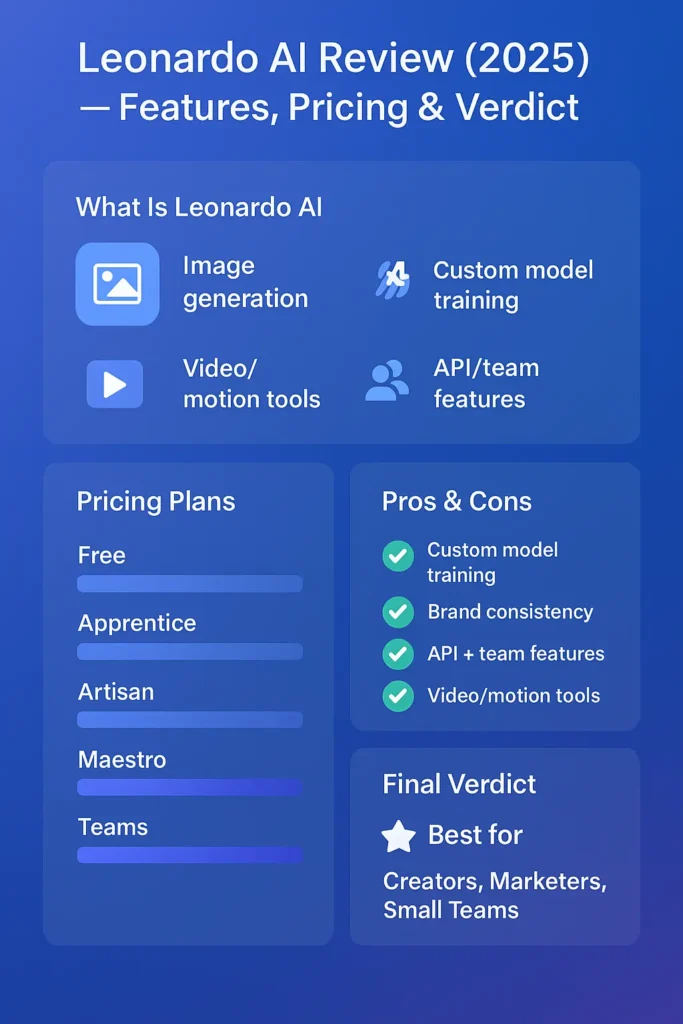
- Custom model training: Managed fine-tuning and adapter workflows to reduce friction for brand-specific distributions.
- Brand consistency: Fine-tuned checkpoints and asset libraries create stable priors for repeated assets.
- API and MLOps integration: Programmatic access and tokenized quotas enable automated pipelines.
- Video & motion tooling: Offers temporal models and conditioning for short-form clips—valuable when you need cross-modal coherence.
Cons (limitations & engineering caveats)
- Conservative creative priors: The platform’s defaults lean toward commercial safety; extreme experimental art may require heavy prompt engineering or external model families.
- Tokenization math: Video and high-res generations are compute-heavy—expect higher cost per successful output.
- Community & plugin ecosystem: While growing, it may not rival communities that produce community checkpoints and prompt recipes as rapidly as some competitors.
- Fine-tuning governance: Managed fine-tuning simplifies adaptation but requires careful dataset curation to avoid overfitting or model drift.
Comparative architecture — Leonardo AI vs Midjourney vs Stable Diffusion
| Feature | Leonardo AI | Midjourney | Stable Diffusion (various UIs) |
| Architectural bias | Brand & production priors; managed fine-tuning | Creative/artist priors, community-driven | Flexible, open weights; requires assembly |
| Image quality (photoreal) | ★★★★☆ | ★★★★★ | ★★★★☆ |
| Video generation | Native temporal conditioning | Limited, plugin/third-party | Requires custom pipelines |
| Custom models | Managed fine-tuning/adapters | Not primary | Yes (self-host) |
| API & programmatic integration | ✅ | ❌ (limited) | ✅ (self-managed) |
| Community/plugin depth | Growing | Very strong | Varies by UI |
Interpretation: Leonardo maps to enterprise-friendly, MLOps-oriented workflows; Midjourney is artist- and community-centric; Stable Diffusion offers maximal flexibility if you have engineering bandwidth.
Integration patterns — MLOps pipeline for teams
A recommended integration blueprint:
- Define distributional target: Define the desired asset manifold—catalog photos, hero banners, character lineups. This determines model selection & fine-tuning scope.
- Curate dataset: Gather labeled assets and meta-prompts; apply augmentation for robustness.
- Fine-tune/train adapters: Use Leonardo’s custom model training to create a brand checkpoint (monitor for overfitting).
- Build prompt library & templates: Store canonical prompts with variables for product, lighting, and angle.
- Implement generation API: Automate generation (A/B variants), perform QA checks, and route accepted assets to CDN.
- Monitor cost & quality: Instrument credit usage per asset; maintain a QA loop to retrain/adapt as brand needs evolve.
- Versioning & governance: Manage model versions and access control; audit outputs for IP and license compliance.
Best practices (prompt-engineering & sampling analogs)
- Prompt templates: Use structured prompts with placeholders (analogous to few-shot context windows).
- Negative prompts: Add explicit negative conditioning to reduce common artefacts.
- CFG / guidance scale: Tune guidance (the equivalent of temperature/beam control in LLMs) to balance fidelity vs creativity.
- Seeds & reproducibility: Fix random seeds for reproducible asset generation.
- Adapters & few-shot: For small datasets, prefer parameter-efficient adaptation (LoRA / adapters) instead of full fine-tuning.
- Automated QA: Use perceptual metrics and human review to filter outputs before publication.
FAQs
Yes — there is a free tier (with limited tokens). You can generate visuals to test the platform before upgrading. From an NLP viewpoint, the free tier is equivalent to a sandboxed inference quota suitable for evaluation and small experiments.
Yes — Leonardo AI allows commercial use under its terms (check the latest T&Cs). In ML terms, confirm license, model provenance, and any downstream usage constraints before using generated assets in monetized products.
You upload your own assets (images, style references), then fine-tune a model in Leonardo AI to reflect your brand’s look and feel. Technically, this is a supervised adaptation pipeline: dataset curation → preprocessing → parameter-efficient fine-tuning or checkpoint adaptation → validation. Subsequent generations will follow that trained style more closely.
Yes — Leonardo AI supports short-form video generation and motion tools. However, video capabilities might have more constraints (length, token cost) than still images. Architecturally, video requires temporal conditioning and heavier computation; expect to manage temporal priors and flow consistency in prompts or auxiliary parameters.
Tokens are the internal credit system. Each generation (image or video) consumes tokens depending on the model used, prompt complexity, and resolution. Plans allocate a token budget per month, or you can top up tokens. Technically, tokens map to compute credits and indirectly to GPU-time & steps used in diffusion sampling.
Final Verdict
From a systems-design and MLOps perspective, Leonardo AI is Engineered to fit team and brand workflows: managed fine-tuning, API access, and media-specific checkpoints minimize engineering bandwidth while preserving quality. If your priorities are reproducibility, brand consistency, and programmatic scale (with a need for short-form motion), Leonardo is a strong candidate.
If your priority is being part of the most experimental creative community, or you need maximum openness to tinker with architecture and weights (self-hosted diffusion variants), you may prefer open-source Stable Diffusion forks or community-driven services.
Key takeaways:
- Use dedicated photoreal checkpoints for product photography; use stylized families for campaign art.
- For brand assets, invest in dataset curation and parameter-efficient fine-tuning.
- Treat tokens as compute credits—instrument and optimize.
- Implement test harnesses: fix seeds, log prompts & parameters, and keep a prompt library for reproducibility.
