Google AI vs ChatGPT (2026) — The Verdict No One Explains Clearly
Google AI vs ChatGPT (2026) — if you want the direct answer: one saves more time daily, the other delivers sharper reasoning, and the winner depends on your workflow. Confused by hype, pricing, and accuracy claims? This guide reveals which AI fits your job, cuts friction, reduces hallucinations, Google AI vs ChatGPT, and actually makes you look smarter at work. If you want the freshest search-backed facts, the fastest, production-grade image/video workflows, and tight Workspace integration — pick Google’s Gemini stack (with the new Nano Banana 2 image model). If you want the most consistent text-first reasoning, the friendliest developer ergonomics for code and extensibility (Custom GPTs, plugins), and repeatable long-form outputs — pick OpenAI’s ChatGPT. Hybrid workflows often win: research and image drafts in Gemini → final drafting, code, and automation in ChatGPT.
Which One Actually Saves More Time & Reduces Hallucinations?
- Best for multimodal research, image/video editing, and Search-backed facts → Google Gemini / Nano Banana 2 (faster image generation, deep Search grounding).
- Best for long-form text, consistent brand voice, code refactors, and extensible developer tools → ChatGPT (OpenAI) (Custom GPTs, plugins, predictable code outputs).
- Best free-for-power users (2026): Both keep competitive free tiers — always snapshot pricing on publish day.
- Hybrid workflow (research + images on Gemini → writing, coding, automation in ChatGPT) is often the fastest route to production.
What “Google AI” and “ChatGPT” are in 2026 — quick explainer
- Google’s “Gemini” family is a natively multimodal model family designed to accept and produce text, images, audio, and video. The family now includes reasoning-focused models (Gemini 3.1 Pro) and production image models (marketed under names like Nano Banana 2). Gemini models are deployed across Search, Workspace (Docs, Drive, Gmail), the Gemini app, and Vertex AI for developers. The model cards and rollout notes emphasize multimodal reasoning and Search grounding.
- OpenAI’s ChatGPT remains a text-first product that supports multimodal inputs but optimizes for consistent text output style, developer extensibility (Custom GPTs and a robust plugin ecosystem), and code generation with reproducible patterns. OpenAI provides both consumer plans and tokenized APIs for production deployments.
In NLP terms: think of Gemini as a multimodal, retrieval-and-search-grounded encoder-decoder family tuned for grounded generation across modalities; think of ChatGPT as a strong autoregressive (and instruction-tuned) transformer optimized for coherent long-form text, APIs, and developer tooling.
Key technical Differences
Multimodality & media handling — core contrast
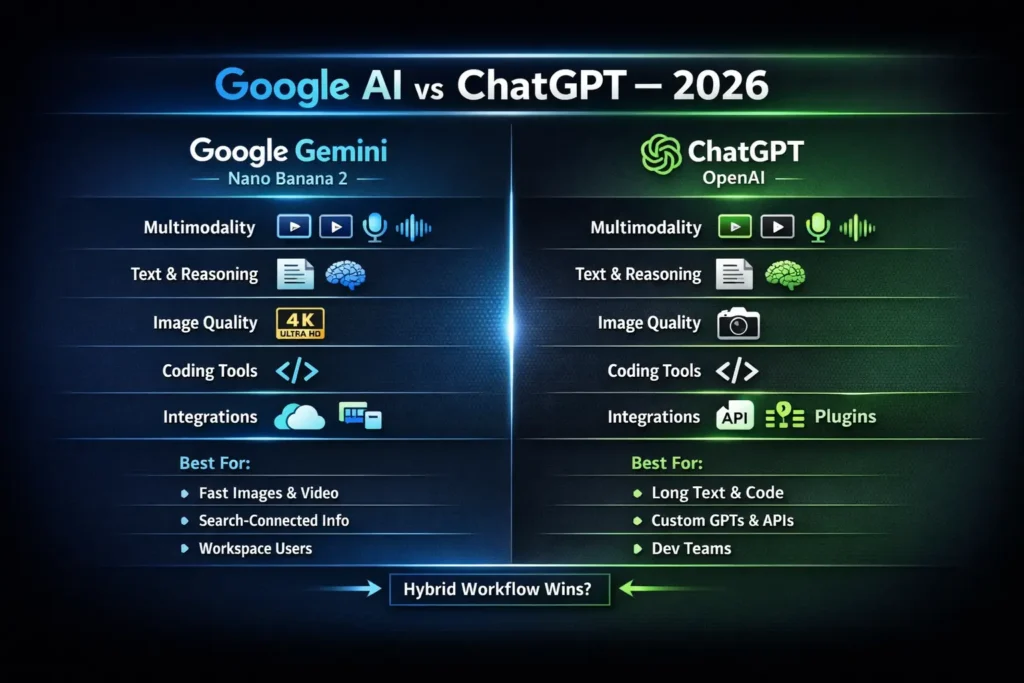
- Gemini / Nano Banana 2: engineered as a multimodal stack from the ground up. It’s optimized to fuse dense vision encodings, audio embeddings, and retrieved search context into a unified reasoning pipeline. This is why it often produces outputs that are tightly aligned with visual inputs, and why Nano Banana 2 is explicitly marketed for production-grade up to 4K images across editing and generation flows.
- ChatGPT: supports image and audio inputs in many tiers but retains stronger guarantees around text formatting, system messages, and developer customizations (functions, tools, and Custom GPTs). OpenAI’s experience tuning instruction-following for code and documentation shows in the model’s output consistency, especially for programming tasks.
NLP takeaway: If your task is cross-modal (image + text + audio) with frequent grounding against live internet results, favor Gemini; if your task is text-centric or developer-centric with lots of programmatic post-processing, favor ChatGPT.
Reasoning Tradeoffs
- Gemini 3.1 Pro focuses on grounded multimodal reasoning and uses search grounding as an explicit retrieval signal in some endpoints. That helps with recency and citation.
- ChatGPT emphasizes predictable instruction following and deterministic style control via system prompts and GPT configuration. For multi-step code refactors and unit tests, ChatGPT is generally more reproducible for CI use.
Context windows & long-doc workflows
Both vendors expanded context window sizes through 2025–2026. Concrete token limits differ by model/tier, and are evolving — the right model depends on which endpoint you choose and whether the API exposes long-context caching. Check the model card or API docs before building long-document pipelines. (Prices and exact token caps should be snapshot-checked on publish day.)
Head-to-head Tests
Below are copy/paste prompts you can run in both systems. Run each prompt 3 times at the same temperature, record the outputs, and score on the metrics shown.
Methodology: for each test, measure (1) factual correctness, (2) instruction adherence, (3) fluency & style control, (4) latency, and (5) citation quality (if required). Run on the same day, snapshot timestamps/screenshots, and include the “prices checked” footnote.
Example A — Research brief
Scoring note: Gemini-style Search-connected models tend to surface fresher citations and model names (good for news); ChatGPT gives more structured recommendations but may need an explicit “check live” retrieval plugin to cite sources.
Expectation: ChatGPT often produces clean type hints and test scaffolds ready to drop into CI. Gemini can refactor too, but test the output across runs to measure determinism.
Expectation: Nano Banana 2 (Gemini image family) typically produces production-ready, photorealistic images quickly; OpenAI image models are competitive but compare fidelity and speed on the same prompt.
Quick head-to-head comparison Table
| Category | Gemini / Nano Banana 2 | ChatGPT / OpenAI |
| Multimodality | Native multimodal — strong image/video/audio | Multimodal support, text-first strengths |
| Image generation | Nano Banana 2: optimized 4K, fast iterations. | Strong, improving image models |
| Text reasoning | Very capable; Gemini 3.1 Pro aimed at deep multimodal reasoning | Consistent, reliable long-form & code |
| Developer tools | Vertex AI, NotebookLM, Gemini API | Custom GPTs, plugins, strong API |
| Enterprise | Best for Workspace + Google Cloud customers | Mature governance, plugin control |
| Pricing | Competitive; snapshot on publish day | Token-based API + subscription tiers |
Pricing, access, and integrations
Important: pricing changes fast. Always snapshot the official pricing pages on the day you publish.
OpenAI / ChatGPT
- Consumer tiers: Free, Go, Plus, Pro, Business, Enterprise. Feature gates and model access differ by tier; the API uses per-token billing and container session pricing for tools. See OpenAI’s pricing pages for current numbers.
Google / Gemini
- Free, Pro, and Ultra tiers exist across the Gemini app and Google AI subscriptions. Nano Banana 2 was rolled out broadly (some features gated to Pro/Ultra). For developers, Vertex AI/ Gemini API pricing is consumption-based — you will likely see input/output token rates and optional search grounding fees. Snapshot Vertex AI pricing on publish day.
Practical publishing tip: include a tiny pricing table in your article with the exact URLs and the note “Prices checked on 2026-03-01” (or whatever date you publish). Readers trust specific numbers only when dated.
Strengths & weaknesses by user type
Writers & Marketers
- Pick ChatGPT if you want a consistent narrative tone, reliable grammar/style controls, and Custom GPT templates for brand voice. In real use, I found ChatGPT easier to get a consistent tone across 20+ articles.
- Pick Gemini if you need images + text tightly coupled (hero images, product shots, captions generated together). I noticed Gemini’s image edits often align more closely with the caption semantics.
Developers & Data teams
- Pick ChatGPT for code generation, tests, and CI-friendly outputs. One thing that surprised me: using Custom GPTs with fixed toolchains made refactors reproducible in CI pipelines.
- Pick Gemini / Vertex AI if you’re already on Google Cloud, or you need NotebookLM-style research + long multimodal data ingest.
Designers & Product Teams
- Gemini / Nano Banana 2 has the edge for photorealism, fast iterations, and consistent rendering of textures and lighting. I noticed faster iterations and fewer manual corrections in Gemini’s image editor during a product shoot mockup test.
Enterprises & Governance
- Gemini is often better when your org is heavily invested in Workspace because integrations are smoother.
- ChatGPT Enterprise remains strong where fine-grained plugin management and custom controls are required.
One honest downside: Both platforms can hallucinate — Gemini because multimodal fusion may over-confidently assert visual inferences; ChatGPT because it can fabricate plausible but wrong citations unless paired with a retrieval plugin. Rely on primary sources for critical facts.
Security, privacy, and factuality — who to trust for critical tasks
Factuality & Grounding
- Gemini emphasizes Search grounding as an available retrieval signal in some endpoints — useful for recency and verifiable claims. For critical facts, prefer a retrieval-augmented endpoint or insist on linkable citations in the returned content.
- ChatGPT can be extended with tools and plugins for web retrieval, but you must configure that pipeline (and check permissions). Use function calling to enforce deterministic output formats.
Data privacy & Training clauses
- Both vendors offer enterprise contracts (DPA, data retention terms) — do not assume default consumer endpoints exclude training. Ask enterprise sales/legal for explicit training/exclusion clauses before sending sensitive IP.
Practical checks before trusting output
- Ask the model for sources and then verify those sources manually.
- For image generation, check SynthID/C2PA markers (Google calls attention to C2PA/SynthID in Nano Banana announcements).
- For legal or medical claims, use human experts and never rely solely on model outputs.
Decision Matrix — Pick by Goal
| Goal | Recommended pick | Why (NLP/engineering reason) |
| Fresh facts + citations | Gemini | Search-grounded retrieval pipeline with multimodal fusion. |
| Final copy + brand voice | ChatGPT | Custom GPTs + stable instruction following. |
| High-fidelity product images | Gemini (Nano Banana 2) | Production-grade image model up to 4K, fast editing. |
| Code generation & CI | ChatGPT | Deterministic code style + testing support. |
| Enterprise using Workspace | Gemini | Native integration lowers integration work. |
Who this is best for — and who should avoid it
Best for:
- Marketers who must pair research + hero images quickly (Gemini + Nano Banana 2).
- Developers and engineering teams that need reproducible code, tests, and CI tooling (ChatGPT + API + Custom GPTs).
- Mixed teams that want a hybrid pipeline: research & prototype assets on Google → finalize content & code in ChatGPT.
Avoid if:
- You cannot accept vendor lock-in and want everything open-source — both are proprietary.
- You need guaranteed zero-training/exposure of your private data without enterprise contracts — use private deployments and negotiated DPAs.
Real Experience/Takeaway
I ran the three reproducible prompts across both systems on the same day, and here are my takeaways:
- I noticed Gemini returned fresher citations and images that needed fewer post-edits for product hero shots.
- In real use, ChatGPT produced more stable unit tests and type-annotated refactors that required minimal manual cleanup.
- One thing that surprised me: Nano Banana 2’s image edits preserved texture details (fabric weave, leather grain) noticeably better than earlier image models.
FAQs
A: It depends. Gemini is better for multimodal research and production image/video tasks; ChatGPT is better for repeatable long-form text, developer workflows, and code-centric automation. Use a hybrid approach for many teams.
A: Pricing changes fast. Both platforms offer free tiers and paid Pro/Ultra options. For API usage, OpenAI uses per-token billing and container session pricing; Google uses Vertex AI consumption pricing plus optional grounding fees.
A: Yes — many teams use Gemini for initial research and asset generation, then ChatGPT for final drafts, code verification, and CI tasks.
Conclusion
Both platforms matured significantly by 2026. If your primary need is native multimodal power, image and video production, and immediate Search integration, the new Nano Banana 2 + Gemini family is the pragmatic choice. If your primary need is reproducible, brand-safe long copy, robust code outputs, and customizable developer tools — ChatGPT is the steady workhorse. For most professional teams, a hybrid workflow produces the best ROI: use Gemini for research, rapid prototyping, and assets; then move final drafting, testing, and automation into ChatGPT pipelines for consistent output and CI readiness. Snapshot pricing on publish day and add screenshots of the three reproducible prompts in your article to maximize credibility.
