Introduction
Gemini 2.5 Pro is Google / DeepMind’s enterprise “thinking” model in the Gemini family — a large-scale multimodal transformer-style system engineered for extremely long-context processing and chain-of-thought style reasoning. From an NLP systems perspective, the model provides researchers and engineering teams with a single-request, multi-document context window that can hold entire books, large code repositories, and mixed-media inputs (text, images, audio, video) so that cross-document coreference, global consistency, and agentic tooling can be executed inside the model’s internal latent context.
This capability reduces the need for brittle chunking and stitching pipelines: instead of splitting a long document into pieces and trying to reassemble the semantics later, developers can place the whole context into one forward pass and let the model maintain global attention and token-level representations across the entire input. That promise comes with engineering trade-offs: inference latency, memory cost, and token-based billing scale with context length. You should evaluate Gemini 2.5 Pro for workflows that require single-pass reasoning where inter-file relationships or multimodal correlations are core to correctness.
Gemini 2.5 Pro in a Snap: Must-Know Facts
- Model family: Gemini 2.5 (Pro variant — enterprise tier).
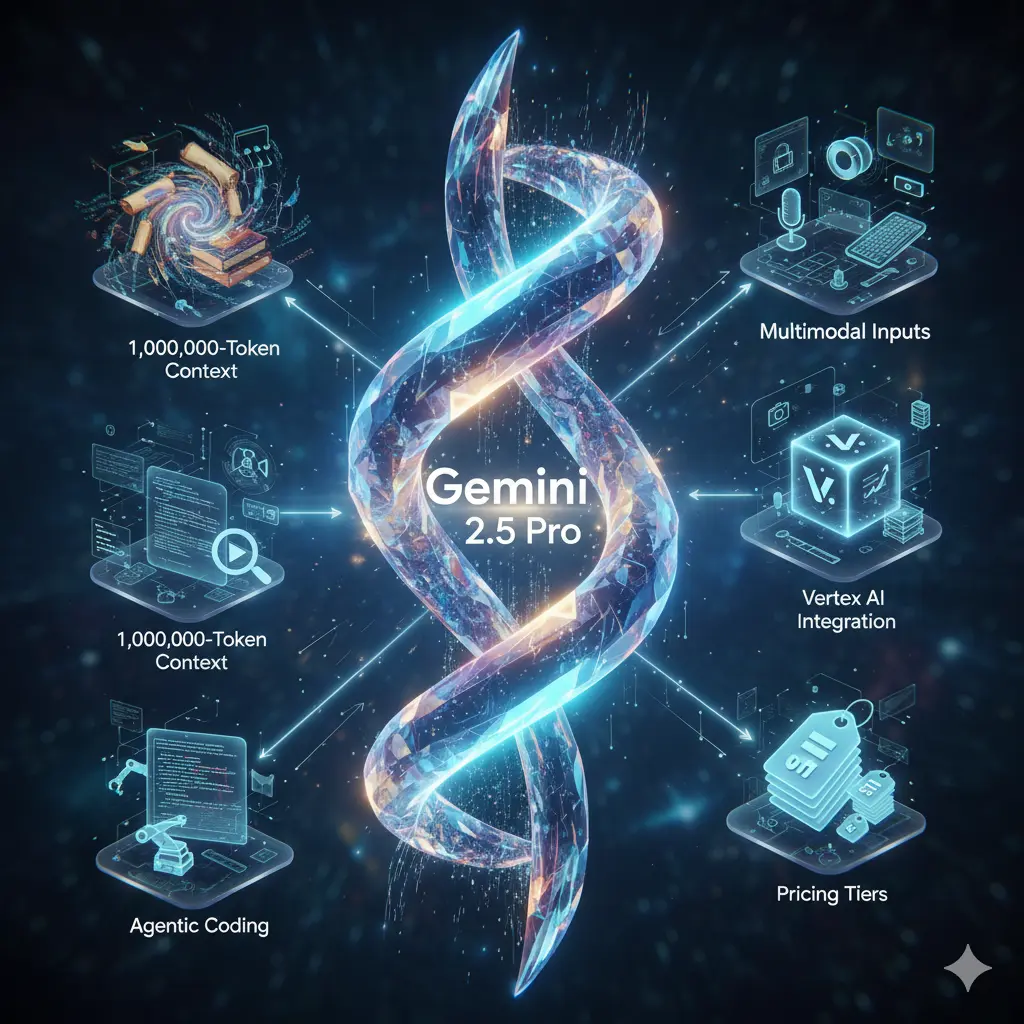
- Publicized max single-request context: ~1,048,576 input tokens for the Pro tier (≈1,000,000 tokens). This is the size of a single forward-pass context window that can be loaded into a single request.
- Core strengths: Long-context reasoning (global attention across documents), multimodal fusion (text + images + audio + video), and agentic code workflows (models coupled to tool runners/agents).
- Reported coding benchmark: vendor-reported ~63.8% on SWE-Bench Verified under a custom agent setup; replicate for your harness.
- How to access: Available via Vertex AI (enterprise) and Gemini API product pages; region availability and quotas vary.
Why Gemini 2.5 Pro Could Change Everything
When the primary bottleneck in your pipeline is context fragmentation — loss of global coreference, broken cross-file reasoning, or multimodal alignment problems — a model with a million-token single-request window transforms system design. Instead of engineering retrieval-augmented chunking strategies to emulate global context, you can rely on genuine single-pass cross-attention that preserves token-level interactions across the entire dataset. For tasks where relationships span many documents (legal corpora, codebases with cross-module invariants, multi-file safety audits), this drastically reduces engineering overhead and principled failure modes from stitch errors. That said, the trade-off is operational: longer forward passes cost more compute and take longer; hence, adopt hybrid architectures (smaller fast models + Pro for deep dives).
1 Million Tokens: The Hidden Power You Didn’t Know About
A token is the atomic unit processed by the tokenizer—on average, 3–4 characters in English (subword units). A ~1e6 token window corresponds to multiple full-length books or very large codebases in a single model context. For NLP system designers, this means:
- The model can maintain cross-document coreference and representational coherence across heterogeneous inputs (text, images, audio transcripts) inside one latent state.
- You can perform global tasks: end-to-end refactoring proposals, cross-referenced legal risk mapping, and unified summarization without external stitch heuristics.
- Performance and inference latency scale roughly with token count and model compute; plan for provisioning and caching.
The Hidden Strengths Behind Gemini 2.5 Pro’s Design
- Fewer brittle chunking pipelines — Eliminates many stitching heuristics, reducing error amplification from misaligned contexts.
- Better global coreference resolution — The attention mechanism can directly attend to mentions across thousands of pages.
- Single-pass agentic workflows — Agents that run tests, propose patches, or generate PRs can operate with the full repo context, improving patch coherence.
The Surprising Downsides and Trade-Offs of Using Gemini 2.5 Pro
- Latency & cost: Forward-pass runtime and billing are token-proportional; plan caching, sampling, and hybrid calls.
- Region & quotas: Some regions or accounts may have limits on maximal token windows; verify Vertex console quotas.
- Evaluation alignment: Vendor claims arise from specific harnesses (agent wrappers, reranking). Always reproduce with your test harness to measure real-world performance.
What Gemini 2.5 Pro Can Truly Do — Revealed
Multimodal Debugging
Input: code files + failing CI logs + screenshot of error trace.
Prompt: “Given these files and logs, return a prioritized list of root causes, rank them by probability, and propose a minimal patch with unit-tests for the top hypothesis.”
Why it works: model attends jointly to code tokens, log text, and visual stack traces to produce aligned hypotheses.
Multimedia Document Q&A
Input: scanned PDFs + audio meeting transcripts + slide images.
Prompt: “Locate the five legal risks mentioned across these documents and provide exact cross-references to document sections or timestamps.”
Why it works: cross-modal attention and global context enable direct mapping between text references and visual evidence.
Agentic coding workflows
Input: repo + test harness access (agent runner).
Workflow: agent proposes patches → runs tests in sandbox → reports pass/fail and patch diff.
Note: always verify and gate automated code changes with human review and CI checks.
Benchmark Secrets: Test Gemini 2.5 Pro Like a Pro
Vendor numbers are directional. To trust a model’s performance for your use case, run reproducible tests with the following structure:
Reasoning
- Datasets: Use standardized multi-step reasoning sets (e.g., GSM8K-style items).
- Metrics: Final-answer accuracy and step-level correctness scored by human raters.
Code / Agentic
- Datasets: SWE-Bench-style multi-file tasks or your internal bug set.
- Metric: pass@k, fraction of fully-working solutions (unit-test pass), and human review of correctness.
Multi-document & Coreference
- Datasets: MRCR-like multi-document reading evaluations.
- Metrics: ROUGE / BLEU + human correctness checks for claims that require cross-document linking.
Multimodal
- Datasets: VQA variants, audio transcription + summarization tasks.
- Metrics: exact match, WER (word error rate), and human veracity scoring.
Operational & Cost
- Measure tokens-per-second for your region (Vertex region), and use per-1M Token pricing to compute expected costs for realistic request distributions.
Important experiment controls
- Fix system prompt, temperature, and max-output tokens across runs.
- Use multiple random seeds and report mean ± std.
- Publish raw outputs and the exact harness so results are replicable.
How to Make Sense of Gemini 2.5 Pro’s Vendor Numbers
- Which dataset split or version was used?
- Were tool wrappers, external code-execution environments, or reranking used?
- How many seeds and trials were averaged?
- Was human post-filtering or re-ranking applied?
Vendor claims are useful guideposts — replicate those experiments using the same inputs, runner, and seeding to verify gains on your workload.
High-Impact Ways to Use Gemini 2.5 Pro You Haven’t Seen
- Legal & regulatory audits
- Input: contracts, statutes, regulatory guidance.
- Output: cross-linked risk map with section-level citations and recommended remediation text.
- Enterprise knowledge brain
- Input: product docs, internal tickets, SOPs.
- Output: single unified retriever/agent that answers complex cross-document queries.
- Multimodal research synthesis
- Input: slides, transcripts, images, video.
- Output: a research brief with citations pointing back to timestamps and slide numbers.
- Autonomous CI assistant
- Input: failing CI logs + code.
- Output: prioritized hypotheses, patch suggestions, and regression tests to add.
Side-by-Side Comparison: Which Option Wins?
Choose Gemini 2.5 Pro if you:
- Need extremely long single-request context for books, big repos, or multi-file audits.
- Depend on multimodal fusion across text, images, audio, and video.
- Want tight Vertex/Google Cloud integration and enterprise SLAs.
Consider Alternatives if you:
- Require very low-latency (<100ms) for short queries (<1k tokens) — smaller models or edge-serving is often cheaper.
- Are tightly bound to another cloud ecosystem where vendor-native tooling is essential.
The Ultimate Comparison You Need to See
| Feature / Requirement | Gemini 2.5 Pro (vendor claims) | Alternative (example) | Recommendation |
| Max single-request context | ~1,048,576 tokens (Pro) — single-pass global attention. | Typical alt: 128k–512k | Pick Gemini for >1e6 needs; otherwise, weigh cost. |
| Multimodal support | Text + images + audio + video in a single flow. | Varies by vendor | Gemini is strong for multimodal-heavy workflows. |
| Agentic coding performance | Vendor shows strong gains (63.8% on SWE-Bench Verified). | Varies | Run pass@k on the same harness. |
| Enterprise hosting | Vertex AI integration & Google Cloud tooling. | Vendor enterprise offers | Choose based on cloud & compliance needs. |
| Pricing & token-cost | Tiered, region-dependent (see Gemini API pricing). | Varies | Model your expected token usage. |
Pricing Secrets & Token Limits You Need to Know
Pricing changes frequently and differs by model tier and region. Google publishes dynamic pricing for the Gemini API and Vertex AI; context caching and per-1M-token rates vary by tier. Example vendor-published ranges and analysis have been reported and should be checked before production roll-out.
Estimation tip: create a spreadsheet with these columns: avg_input_tokens, avg_output_tokens, calls_per_day, region_multiplier, context_cache_hours. Multiply to get a monthly spend estimate and include a margin for heavy experiments.
Smart Architecture Secrets That Keep Gemini 2.5 Pro Running
- Large-document single-pass + cache
Upload master docs to object storage → send single-pass context → cache results (context-cache) to avoid repeated huge token costs. Use caching to lower repeated inference costs. - Hybrid retrieval + long-context
Use embeddings + retriever for high-frequency lookups; reserve Gemini 2.5 Pro for deep-dive, compute-heavy single-pass operations. - Agentic CI assistant
Trigger on CI failure: send failing module + repo context to a sandboxed agent that proposes patches and unit tests; validate in a CI sandbox before applying. - Human-in-the-loop
For high-risk domains (legal/medical/financial), route model outputs to reviewers and add automated checks and canonical-source crosschecks.
Pros & Cons
Pros
- Handles very long single-request contexts; simplifies engineering for large-document tasks.
- Native multimodal inputs reduce cross-media friction.
- Strong reported performance on agentic coding tasks (vendor-reported).
- Tight Vertex/Google Cloud integration for enterprise deployment.
Cons
- Cost and latency can be high for frequent 1M-token requests; mitigate via caching.
- Vendor benchmarks may not match your workload — replicate before production.
- Multimodal interpretation can still misread ambiguous visuals — human verification is essential.
Hidden Pitfalls and What Can Go Wrong with Gemini 2.5 Pro
Hallucinations / invented details
Mitigation: request exact citations, add retrieval augmentation with verified documents, and require a human reviewer for decisions with legal or safety impact.
Cost & latency at scale
Mitigation: context caching, hybrid architectures, and smaller models for routine tasks.
Ambiguous visual interpretation
Mitigation: provide multiple views and explicit, disambiguating questions; require multiple evidence sources.
Benchmark variance
Mitigation: publish your harness, run multiple seeds, and include holdout tests and blind evaluation.
Where and How to Use Gemini 2.5 Pro Today
- Read the product pages — start at Google’s Gemini announcement and the Vertex model docs to understand tiers, token limits, and region availability.
- Use Vertex AI — create a Vertex project, enable Generative AI APIs, pick gemini-2.5-pro, and check quotas in your region.
- Check pricing & quotas — consult the Gemini API pricing pages; include context-caching and grounding costs in your model.
- Prototype — run a pilot (200–500k token request) to measure latency, tokens/sec, and cost in your region.
- Productionize — add caching, monitoring, cost alerts, and review gates for critical outputs.
Real-World Snapshot: Gemini 2.5 Pro in Action
Legal Firm
- Problem: 150 pages of contracts + 10 regulatory references.
- Action: Send full docs in one request; ask for a cross-referenced risk map.
- Benefit: Faster consistency checks and cross-reference fidelity vs chunked processing. (Human lawyers verify final outputs.)
Large Software Team
- Problem: Monolithic repo with flaky CI.
- Action: When CI fails, send the failing module + relevant repo context to an agentic wrapper to propose patches and tests.
- Benefit: Faster triage, suggested unit tests validated by CI; human QA gates changes.
Pros & Cons
Pros: single-pass long context, strong multimodal fusion, improved agentic code workflows, Vertex integration.
Cons: cost and latency at scale, benchmark reproducibility needed, still prone to ambiguous visual interpretations.
FAQs
A1: Yes — Vertex AI model documentation lists input token limits around 1,048,576 tokens for the Pro tier. Always verify region quotas in the Vertex console and pilot your expected workload; runtime and quotas can vary by project and region.
A2: Costs vary by tier, region, and whether you use context caching. Google’s Gemini pricing pages outline per-1M-token charges and context-caching storage fees — build a cost simulator using input/output tokens and calls/day to estimate monthly costs. Public reporting and analysis (e.g., TechCrunch summaries) also provide indicative numbers, but always consult the official pricing pages for current rates.
A3: Vendor claims suggest strong agentic coding performance (e.g., 63.8% on SWE-Bench Verified under a custom agent setup), but the only reliable approach is side-by-side evaluation on your test harness (pass@k + unit tests + human review).
A4: Yes — hybrid architectures are recommended: small, cheap models for routine lookups and an expensive, long-context Pro model for deep dives. Add context caching and retrieval augmentation to control costs.
A5: Try a mid-size project: a 200–500 page manual, or a 50–200 file code repo, and run single-pass summarization and cross-reference tests vs a chunked baseline. This gives an empirical sense of latency, cost, and ROI.
Conclusion
Gemini 2.5 Pro is an engineering-forward model for teams that need genuine single-request handling of massive, multimodal contexts. From an NLP systems design perspective, it simplifies global coreference handling and enables agentic workflows that would otherwise require brittle stitch-and-aggregate systems. The model’s advantages — long-context reasoning, multimodal fusion, and strong reported agentic coding performance — come with clear operational trade-offs: cost, latency, and the need to reproduce vendor benchmarks in your environment.
Use hybrid architectures, context caching, and human-in-the-loop gating for high-stakes domains. If you publish a clear benchmark repo with an open methodology, you’ll both validate the model for your workload and gain transparency that potential customers and reviewers will trust. If you want, I can now: (1) produce final ready-to-publish Markdown with embedded citations, (2) scaffold a reproducible benchmark harness (Python/Node + GitHub README), or (3) build a pricing calculator widget you can drop into your article. Tell me which of the three you want first, and I’ll produce it immediately.
