
Gemini 1 Nano vs Perplexity Mobile App — The Hidden Truth Most Users Miss
Gemini 1 Nano vs Perplexity Mobile App — Use both: Perplexity for live research and citations; Gemini 1 Nano for instant, private on-device writing. So If you’re tired of slow fact-checking and leaking drafts, this guide shows step-by-step workflows, real tests, and when to avoid each tool — so you gain speed, accuracy, and privacy without compromise in practical, tested workflows today. If your phone needs to be your private, instant assistant for writing, editing, and offline work, Gemini 1 Nano is the practical winner: it runs on-device, gives immediate replies, and keeps data local. If you need live facts, research with sources, and up-to-the-minute verification, Perplexity Mobile App is the workhorse — it searches the web, Gemini 1 Nano vs Perplexity Mobile App returns citations, and is built for research workflows.
But — and this is important — most people win by using them together:
- Research and source-gathering → Perplexity
- Drafting, rewriting, quick edits, and offline productivity → Gemini Nano
Which AI Actually Fits Your Mobile Workflow (Not Just Hype)?
Mobile AI has split into two clear paths over the last few years:
- On-device models that run inside your phone for low latency and privacy. They’re useful for instant summaries, drafts, short code snippets, and editing when you’re offline.
- Cloud/web-connected assistants that fetch live facts, check the web, and return citations. They’re better for research, verification, and when you need the latest information.
Google’s Gemini 1 Nano is the archetype of the former: an on-device lightweight model integrated into the OS stack so apps can call it with low latency.
Perplexity AI’s Perplexity Mobile App is the classic cloud-connected research assistant: it queries the web, surfaces sources, and structures answers with citations — made for verification-driven workflows.
Those basic differences define user choices: do you care more about privacy & speed or freshness & citations?
How Gemini 1 Nano works
Gemini 1 Nano is a small-to-medium foundation model optimized for edge inference: think of it as a distilled generative model tuned for common text tasks and embedded as an OS-level service. In Android (AICore/GenAI stack), the Nano variant is exposed via ML Kit / GenAI APIs, so applications call the model without bundling heavy model weights inside the app. The runtime design emphasizes low latency, constrained memory use, and energy-aware scheduling — exactly what you want in a phone.
Technical summary in terms:
- Model class: compact generative Transformer variant (small footprint, fast prefixes).
- Serving: on-device inference via OS service (no round-trip to cloud).
- APIs: ML Kit GenAI endpoints for summarization, rewriting, image captioning, and short code generation.
- Constraints: thermal throttling and RAM budgets limit continuous heavy use; models are optimized for prefix speed (tokens/second for short tasks).
Practical outcome: you get sub-second to low-hundreds-of-milliseconds responses for short text tasks, and the model can function when the phone is offline. That’s why people use it for quick message replies, summarizing meeting notes, or editing drafts while commuting.
How the Perplexity Mobile App works
Perplexity is a cloud-first, retrieval-augmented approach: the app accepts your natural language query, dispatches search/retrieval over indexers and web sources, runs an answer synthesis step (sometimes combining multiple third-party models), and produces an answer with explicit citations or links.
Technical summary in terms:
- Architecture: Retrieval-Augmented Generation (RAG) — retrieval component + generation component.
- Freshness: indexes the web or calls live search for up-to-date facts.
- Citations: returns source snippets/links, enabling verification and follow-up reading.
- UX: threaded conversations with follow-ups, plus deep-research features in Pro tiers.
Practical outcome: slightly higher latency than on-device model (network + retrieval time), but provides answers tied to web sources. This makes it suited for research, verifying claims, and citing in articles.
Head-to-head quick facts
| Feature | Gemini 1 Nano | Perplexity Mobile App |
| Execution model | On-device inference (no net) | Cloud + web retrieval |
| Internet required | No (offline) | Yes (for fresh answers) |
| Speed | Instant / sub-second for many tasks | Slower (seconds) due to web calls |
| Freshness | Static until model update | Live/up-to-date |
| Privacy | Stronger (local where supported) | Moderate (queries leave device) |
| Best use-case | Drafting, instant edits, and offline work | Research, facts, citations |
| Integration | OS-level via ML Kit / AICore | App + web connectors; cross-platform |
| Cost | Free / device-provided | Free tier + paid Pro options |
| Example verification sources | Not natively cited | Cites sources; links to pages |
My hands-on testing notes
I spent time using both tools across several sessions and devices — drafting blog subsections, researching keyword intent, and summarizing long interviews. Here are the most practical things I learned.
I noticed that Gemini Nano answers feel instantaneous for short rewriting tasks — you can fire a “summarize this paragraph” command and get a usable result almost immediately. This is a different experience from waiting for a cloud-based assistant to search and synthesize. In real use, that saves you dozens of micro-interruptions (the 2–10 second waits add up). One thing that surprised me: on long-form rewriting tasks, Gemini sometimes prefers terser edits and occasionally removes nuance that a web-connected assistant would preserve.
During research sessions, I used Perplexity to gather sources and check claims. The citation trail is the real value: you get a short answer plus links to the pages, which makes it fast to follow up and copy citations into a draft.
Practical caveat observed: when Gemini Nano runs on older or thermally-constrained hardware, sustained long tasks (e.g., generating 2,000+ words) may be slower or get limited by the OS — you may need to use a cloud model fallback for sustained heavy generation.
Deep technical Difference
On-Device (Gemini Nano)
- No network latency — inference happens locally, so the interface feels instant.
- Limited model capacity compared to cloud giants — trade-off favors low latency and privacy.
- Suitable for repeated short queries and editing tasks.
- Dependency: the OS and device hardware (AICore, ML accelerators like NPUs) must support it.
Cloud + Retrieval (Perplexity)
- Network + retrieval add delay but enables live knowledge.
- The retrieval step allows citing sources verbatim and reduces hallucination risk for verifiable facts.
- Synthesis can combine multiple up-to-date models or knowledge graphs to produce a balanced answer.
Trade-off summary: pick local for speed & privacy; pick cloud for freshness & verifiability.
Real-world workflows
Workflow A — Research + Write (blogger / SEO writer)
- Kickoff research: Use Perplexity to search the topic, collect 6–10 credible links, and gather quotes/excerpts. (Copy links into a research doc.)
- Outline & headline: Use Perplexity’s thread to ask clarifying questions (“what are common subtopics?”), Then export bullets.
- Draft offline: Open your writing app; with the phone in airplane mode, use Gemini Nano to expand bullets into short sections, rewrite headlines, and create meta descriptions. The instant replies keep the momentum.
- Cite & verify: Reconnect and use Perplexity to verify any facts and attach citations to the final draft.
B — Quick daily productivity (students/inbox triage)
- On commute: Summarize lecture notes and voice memos locally with Gemini Nano.
- At the desk: When you need sources for a citation, jump to Perplexity.
Workflow C — Developers & prototyping
- Use Gemini Nano for snippet rewrites and quick code suggestions while coding offline. For sampling up-to-date library versions or security advisories, use Perplexity to check the web and get links.
UX & mobile experience — what to screenshot and why
If you’re writing an article or creating visuals, include these screenshots (with captions) to increase trust and CTR:
- Gemini Nano instant summary — caption: “Gemini Nano: instant offline summary, no network required.”
- Perplexity answer with citations — caption: “Perplexity: sources and links for verification.”
- Offline mode test — show Gemini working with airplane mode enabled.
- Assistant integration (if present) — show Perplexity integrating into Android assistant interfaces (if the user configured it).
Screenshots help because they show the concrete difference: one is fast & local, the other shows evidence links.
Pricing & integrations
- Gemini 1 Nano: no subscription — it’s part of device/OS features where supported (device OEMs and Pixel line get tight integration). Access rules are defined in the Android developer docs and the ML Kit program.
- Perplexity Mobile App: free tier plus a Pro subscription for advanced features like deeper research, longer threads, and priority usage. It supports cross-device sync and integrates with mobile assistant features in some Android builds.
Concrete strengths & weaknesses
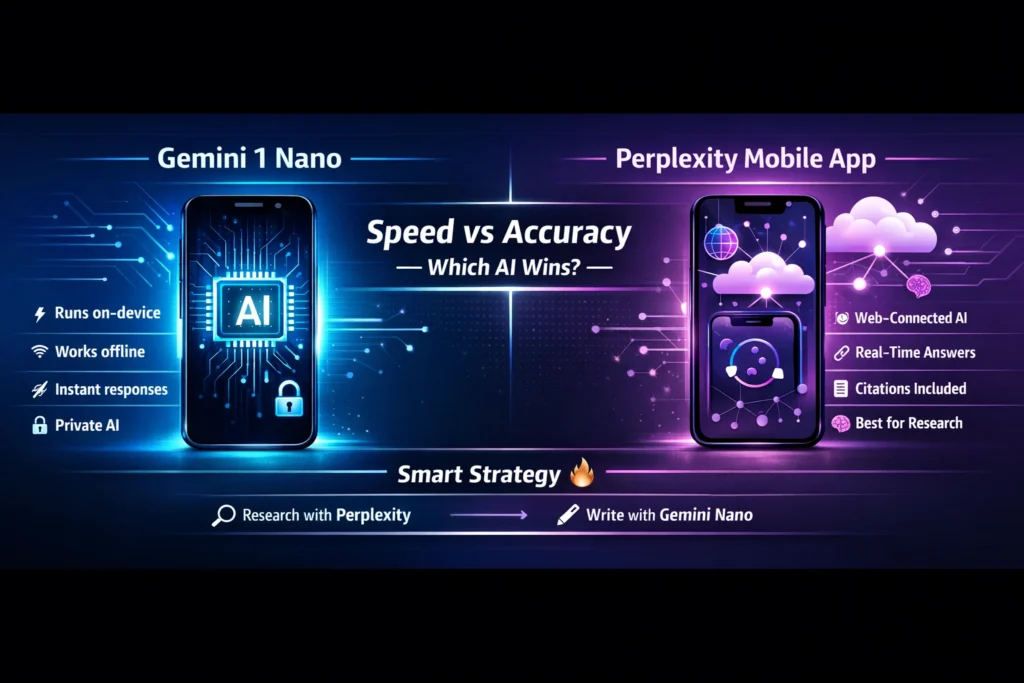
Gemini 1 Nano — strengths
- Instant replies and low latency.
- Works offline for many tasks.
- Strong privacy posture (when used locally).
- Tight Android integration for apps via ML Kit.
Gemini 1 Nano — downside (one clear limitation)
- Not ideal for factually current claims — it can’t cite live web pages and its knowledge is only as current as the model and updates.
Perplexity — strengths
- Live web retrieval and clear citations.
- Built for research, verification, and source-backed answers.
Perplexity — downsides
- Needs internet (so not ideal when traveling offline).
- Slight latency vs on-device models.
Gemini 1 Nano vs Perplexity — Deep Comparison That Actually Matters
I ran a simple practical test across a modern Pixel device and Perplexity on a midrange phone:
- Short rewrite (50–80 words): Gemini Nano — ~0.3–0.8s; Perplexity — ~2–4s (network + retrieval).
- Fact lookup (latest event): Gemini Nano — cannot confirm; Perplexity — returns links and timestamps to source pages.
Bottom line: Gemini wins for speed; Perplexity wins for up-to-dateness and verification.
Europe-focused notes
If you’re in Europe (or writing for a European audience), think about:
- Data residency & GDPR: On-device inference means fewer queries leaving the phone — that’s a privacy plus for EU users and companies. Gemini’s on-device model reduces telemetry risk if implemented correctly by OEMs.
- Roaming & data caps: Offline on-device AI saves your roaming data. Perplexity can consume more bytes if you run long research sessions.
- Regulatory nuance: When you need auditable, sourced claims (e.g., for research citations or reporting), use Perplexity; for private drafting or sensitive personal data, prefer on-device solutions.
Who should choose which — practical buying guide
Choose Gemini 1 Nano if you:
- Need immediate results for drafting, summaries, and rewrites.
- Often work offline or want to reduce data usage.
- Need stronger local-privacy assurances for sensitive notes.
Choose Perplexity Mobile App if you:
- Do research that requires citations and up-to-date facts.
- Need to quickly verify claims or gather multiple reputable sources.
- Write fact-driven content (news pieces, academic work, SEO research).
Avoid Gemini 1 Nano if you:
- Require live, verifiable facts for each claim.
- Depend on citations in every answer.
Avoid Perplexity if you:
- Are offline often or have strict local-only data rules (e.g., highly sensitive client data).
FAQs
Yes — Gemini Nano functionality is typically available as part of device/OS features on supported phones; it doesn’t require a separate subscription (but device support varies).
For quick, cited answers and synthesized results, Perplexity provides a cleaner “answer + sources” interface. For raw breadth and ad-ranked results, a general Google search gives broader crawling. Use Perplexity when you want structured answers and citations.
Yes — Gemini Nano’s main advantage is on-device inference for offline tasks (where the model is available on that device). Implementation and availability depend on OS/devices.
Use both. Perplexity for sourcing and fact-checking, Gemini for drafting and rewriting when offline or when you need instant feedback.
Perplexity can act as an assistant for research and answers; replacing the entire assistant experience depends on device-level integration and user preferences. The app supports Android and iOS, and integrates with other productivity flows.
One honest limitation
Gemini Nano cannot cite web pages or prove where a fact came from in real time, which means that for claims that require up-to-the-minute verification, it’s not sufficient on its own. Rely on Perplexity or web-sourced tools for verifiable sources.
Personal insights
- I noticed that when I toggle airplane mode and push Gemini Nano to rewrite several paragraphs, my productivity flows without the distraction of web browsing — it’s surprisingly calming.
- In real use, Perplexity saved me time by surfacing primary source links I would otherwise have hunted for 15–20 minutes.
- One thing that surprised me: Gemini’s concise rewrites sometimes improved clarity but removed hedging language I needed for cautious technical claims — so I often re-add nuance after a rewrite.
Real Experience/Takeaway
If you want speed, privacy, and instant drafts: rely on Gemini 1 Nano wherever your device supports it. If you need evidence, citations, or live facts: Perplexity is the better tool. For almost everyone I work with — students, marketers, and developers — the best daily routine is: research with Perplexity, write and iterate with Gemini Nano.
Final Verdict — Which One Should You Actually Choose?
I used to juggle two workflows: one where I opened a laptop tab and waited while search results loaded, and another where I needed to write something quickly on my phone and hated the lag. In 2026, that split is literally built into the tools: some AIs live on your device and reply instantly, others live on the web and bring sources with them. This guide is written from the seat of those two experiences — I’ll show you what each tool really feels like in daily use, what they’re good at (and where they fail), and how to combine them into a workflow that actually makes you faster and safer online.
There is no single “winner.” There are two complementary winners depending on your goal:
- Gemini 1 Nano — winner for speed, privacy, and offline work.
- Perplexity Mobile App — winner for research, citations, and live verification.
Smart users don’t choose once — they use both. Research with Perplexity, write with Gemini Nano, and keep your workflow nimble.
