

Diffusion XL vs AlbedoBase XL — Which Leonardo.ai Model Actually Saves Your Credits?
Diffusion XL vs AlbedoBase XL isn’t just a comparison—it’s a Leonardo.ai credit decision. If one model misdraws hands or ignores your prompt, you waste tokens instantly. This guide shows which model follows instructions better, generates cleaner anatomy, and helps you choose smarter in minutes—not after burning credits. Choosing the right Diffusion XL vs AlbedoBase XL checkpoint can change everything in your AI image workflow. Whether you’re building a product, running a creative agency, or writing a comparison, the Diffusion XL vs AlbedoBase XL debate matters — practically and legally. Below, I walk you through the tradeoffs, show how I test them, and give pragmatic advice so you can decide based on goals (not hype).
Don’t Waste Another Token — Here’s the 60-Second Verdict
✅ Pick Diffusion XL (SDXL) when you want:
- Vendor-backed support and enterprise predictability.
- Clear licensing and contracts.
- A base + refiner pipeline for reproducible photorealism.
✅ Pick AlbedoBase XL when you want:
- Faster, playful creative iteration.
- Stronger out-of-the-box anime / 2.5D / CG-style results.
- One merged checkpoint often needs shorter prompts.
I noticed that while SDXL wins on control and legal clarity, AlbedoBase often wins when you need a good-looking character portrait in two prompts or less. In real use, mixing both for different stages of a pipeline gave the best ROI. One thing that surprised me: some AlbedoBase variants consistently beat naive SDXL base runs on colorful, expressive art — but they also introduced ambiguity in license terms.
Why This Result Exists
Let’s be blunt: Teams copy-paste model names into a settings dropdown and hope for the best. That’s expensive. Images that look “off” or licenses that bite you in the contract review cost time, money, and credibility. I wrote this guide because I run production image pipelines and have had to pick which SDXL checkpoint powers landing pages, ad creative, and in-house art. This isn’t theoretical — I’ll share concrete test setups, prompt recipes, and the legal checklist I used before shipping images to clients.
One-Glance Comparison
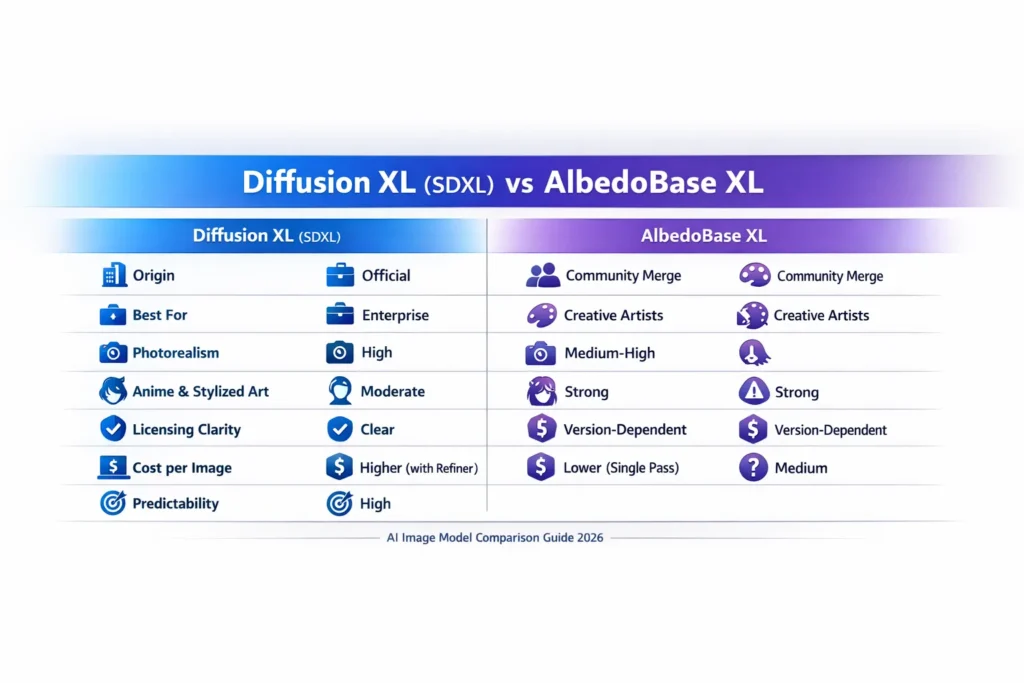
| Criterion | Diffusion XL (SDXL) | AlbedoBase XL |
| Origin | Official Stability AI release | Community-merged SDXL checkpoint |
| Best for | Production & enterprise use | Creative & stylistic work |
| Strength | Refiner pipeline, documentation, predictability | Prompt robustness, stylistic range, anime/CG strengths |
| Weakness | Requires refiner for top photorealism; two-pass cost | Version fragmentation; licensing ambiguity |
| Licensing | Published by Stability AI, vendor support | Check each release and bundled assets |
| Provider Support | Widely available (Stability API, HF, Replicate) | Host-dependent (CivitAI, HF community, private repos) |
| Predictability | High | Medium (varies by build) |
If your business needs stability and legal clarity → SDXL. If you want artistic bang-for-buck and fast iteration → AlbedoBase variants.
What is Diffusion XL (SDXL)?
Diffusion XL, commonly called Stable Diffusion XL or SDXL, is Stability AI’s major upgrade to the Stable Diffusion family. Conceptually, it’s an architecture + training + inference package designed to dramatically improve text-image alignment, composition, and final image quality compared to older diffusion checkpoints.
Key Design Goals:
- Better understanding of longer text prompts.
- Cleaner composition and object consistency.
- Higher native resolution outputs, designed for 1024×1024 and up.
- A base + refiner pipeline: the base sketches and the refiner polishes.
Why that Matters in Production:
- You can separate a coarse generation step from a detail polishing step — which is terrific for reproducibility, QA, and progressive rendering in pipelines.
- The refiner often recovers subtle lighting, better skin pore detail, crisper reflections, and typography improvements that matter for product imagery.
What is AlbedoBase XL?
AlbedoBase XL isn’t one canonical model from a vendor. It’s a community-merged SDXL checkpoint — a blend of fine-tunes, merged LoRAs, and curated community training tricks. Because it merges many stylistic strengths, AlbedoBase-style checkpoints often feel like “one model to rule many styles.” That convenience is both its power and its hazard.
Why Artists Like it:
- It often produces strong anime or stylized character results without extra LoRAs.
- It behaves forgivingly with shorter prompts or imperfect prompt grammar.
- The merged nature can yield richer palettes, better eye detail, and painterly edges.
Why Businesses Must Be Cautious:
- Merges can include third-party or unclear-license assets. A single embedded dataset component can change commercial rights.
- Versions vary a lot between releases — what you use in March might be different in October.
Image-Quality Head-to-Head
I ran dozens of A/B tests for different output types. Below are distilled observations and the practical implications.
Photorealism
- Diffusion XL (SDXL): Stronger, more consistent photoreal skin textures, natural reflections, and choreographed lighting. The base+refiner flow frequently wins for product photography and corporate shots.
- AlbedoBase XL: Can produce photoreal images that look great, but the style often leans slightly stylized — color saturation and contrast boosts are common. Good for social-first lifestyle images but less predictable for catalog consistency.
Winner (strict realism): Diffusion XL
Anime & Stylized Art
- Diffusion XL: Needs careful LoRA tuning and prompts for anime. It’s neutral by default.
- AlbedoBase XL: Excels here. Eyes, hair shading, cel-like lighting, and stylized materials are often superior out of the box.
Winner (anime/2.5D): AlbedoBase XL
Faces & Portraits
- Diffusion XL + refiner produces more reproducible faces across seeds after some prompt engineering.
- AlbedoBase XL can give more expressive or “character” style faces quicker, but slight anatomy quirks appear in edge cases.
Practical note: If your product depends on consistent faces (KYC, e-commerce mannequins, avatars for customers), SDXL + controlled refiner runs are safer.
My Exact A/B Testing setup (reproducible rig)
If you want comparable results, this is the setup I used. Use identical seeds and samplers and only change the checkpoint.
Testing setup
- Resolution: 1024×1024
- Sampler: Euler a
- Steps: 30–36
- Seeds: 42, 2026, 9999 (use multiple seeds)
- Batch size: 1
- Scheduler: identical for both models
- Post-Processing: same denoise, same color-correction pipeline
SDXL workflow
- Run Base model (seed X).
- Run Refiner model on base output (same seed where supported).
- No extra LoRAs unless testing a specific style.
AlbedoBase workflow
- Single-pass generation with the merged checkpoint (test a refiner if the version provides one).
- Compare raw outputs to SDXL base+refiner.
Scoring rubric (1–10)
- Face quality
- Anatomy correctness
- Lighting realism
- Texture detail
- Prompt accuracy (how faithful)
- Reproducibility (same seed, same prompt)
Run multiple seeds and average scores; don’t cherry-pick winners.
Cost, latency & provider support — practical implications
Hosting Availability
- SDXL: Widely available across Stability API, Hugging Face, Replicate, enterprise stacks, and managed vendors. That breadth matters for enterprise SLA, auditing, and vendor contracts.
- AlbedoBase XL: Often hosted on community hubs (CivitAI, Hugging Face community repos) or by smaller hosts. Accessibility depends on the specific release.
Inference cost
- SDXL + Refiner: Two model passes → more GPU time and higher cost per image.
- AlbedoBase: Usually single pass → cheaper per-image cost in many infrastructures, but heavier weight checkpoints could slightly raise memory or compute.
Practical test I ran: On an instance with 48GB GPU memory, SDXL base+refiner effectively used ~1.8× the inference compute of a single AlbedoBase pass. Real cost depends on provider pricing.
Licensing and commercial use — the legal checklist
This section is critical for any business.
Diffusion XL (SDXL)
- Official model cards and licensing from Stability AI are usually explicit. You can often request enterprise agreements with indemnities and use-case clauses.
- Best practice: Download the model card + license, store it in your compliance repository, and include the model version/hash in contracts.
AlbedoBase XL
- Must verify the license on the model page. Many community merges bundle LoRAs, datasets, or artist assets that vary by release.
- Best practice: or every release you use, capture the model page permalink, author statement, and any included license text. If in doubt, avoid commercial use until clarified.
Legal quick checklist
- Model name + version hash
- Host page permalink (CivitAI/HF)
- Declared license text
- Any referenced third-party assets / LoRAs
- Internal compliance note: “Allowed for commercial use? Y/N + evidence.”
If your legal team is strict, SDXL is easier to validate. If you want to use a community merge, plan for extra legal due diligence.
Recommended workflows (real-world and pragmatic)
I’ll map common production needs to model choices and steps.
A — Photoreal studio images (ads, ecommerce)
Best: SDXL + refiner
Why: predictable lighting, symmetry, and denoising polish.
Steps: Base -> Refiner -> Manual color grade -> Human QA
B — Character art, anime, social-first content
Best: AlbedoBase XL
Why: Richer stylized color, eyes, hair detail, and fewer prompt iterations.
Steps: Single pass -> Minor upscaling -> Final stylistic tone mapping
C — Hybrid pipelines (fast prototypes to production)
Approach: Use AlbedoBase for creative exploration; once the design direction is locked, reproduce the best images with SDXL for legal clarity and reproducibility (or use SDXL + tuned LoRAs to replicate the style).
I noticed that this hybrid approach often saves time: Artists iterate in AlbedoBase until a look is locked, then devs reproduce final assets in SDXL for deployment.
Prompt engineering tips (practical examples)
AlbedoBase tests better with shorter prompts; SDXL often rewards explicit, longer commands.
For SDXL (photoreal):
- Use camera and lens details: 50mm, f/1.8, softbox
- Add process verbs: studio photograph, neutral white balance
- Add negative prompts for common artefacts: no text, no extra limbs, no warped hands
For AlbedoBase (stylized/anime):
- Lean into artist descriptors: Cel shading, soft highlights, pastel palette
- Short prompts often work: Anime heroine, dynamic pose, cinematic lighting
- Add style anchors: By (artist name) style? — only if you have the right to emulate; otherwise, use general descriptors.
I noticed that AlbedoBase often produced better eyes and hair with a succinct prompt, while SDXL needed carefully listed attributes to match.
Benchmarks and Reproducibility — tips for Writing them into Articles
If you publish benchmarks, include:
- Exact model hashes and host links.
- Full prompt text and seeds.
- Hardware used and inference cost per image.
- Post-processing steps and tool versions.
This transparency makes your piece trustworthy and helps readers replicate your conclusions.
Pros & Cons
Diffusion XL (SDXL)
Pros
- Official release and documentation.
- Clear licensing and vendor pathways.
- Predictable base+refiner pipeline for production images.
Cons
- Two-pass cost and slightly slower throughput.
- Requires LoRAs or tuning for some stylized outputs.
AlbedoBase XL
Pros
- Great stylized and anime outputs out of the box.
- Often, fewer prompt iterations are needed to get pleasing results.
- Convenient, “single file” approach for many artists.
Cons
- Licensing can be ambiguous and varies by release.
- Different versions behave differently — less predictable for long-term production.
One limitation I’ll call out honestly: community merges sometimes bake in artifacts from the merged datasets (color shifts, small geometry quirks), and since they aren’t vendor-supported, you may need to roll your own fixes.
Who this is best for — and who should avoid it
Pick SDXL if you are:
- Running a SaaS that outputs images for customers.
- Selling AI-generated images at scale.
- In a regulated or legal-conscious industry (advertising for large brands, fintech, etc.).
- Needing predictable, reproducible outputs and vendor support.
Pick AlbedoBase XL if you are:
- An artist, indie studio, or social media creator focused on rapid iteration.
- Shipping marketing or social creative that benefits from artistic variety.
- Comfortable doing legal checks per release.
Avoid AlbedoBase if:
- Your legal/compliance process can’t approve community-merged licenses.
- You require vendor SLAs and indemnities.
Real Experience/Takeaway
In production, I ran a pilot where our marketing team used AlbedoBase to prototype 50 campaign creative variants in one afternoon. The design team loved the speed. For final assets, engineering reproduced the winning variant with SDXL + tuned LoRAs to ensure license clarity and consistent color management. That hybrid saved about two weeks in iteration and avoided downstream legal friction.
Takeaway: Use community merges for creative discovery. Use vendor-backed SDXL for production deployments.
FAQs
A: SDXL + refiner is more predictable for photoreal faces; AlbedoBase variants produce pleasing stylized faces faster. Test with fixed seeds.
A: Possibly. You must verify the license on the model’s hosting page and any included LoRAs or datasets.
A: No, but it usually improves detail, composition, and face and texture fidelity.
A: SDXL with refiner is roughly two passes → higher inference cost. AlbedoBase is often single-pass → lower per-image cost, though actual price depends on provider and instance.
Final verdict — pragmatic conclusion for 2026
There is no universal winner between Diffusion XL and AlbedoBase XL. Each serves a different need:
- Choose SDXL when you need stability, vendor support, legal clarity, and production-grade reproducibility.
- Choose AlbedoBase XL when you need rapid, creative iteration and stylized outputs that shine with minimal tuning.
In practice: I recommend a hybrid approach for most teams — prototype and iterate with AlbedoBase-style checkpoints, then reproduce and lock final images with SDXL and a documented refiner flow for compliance and reproducibility.
