
ChatGPT Without Restrictions — The Truth Nobody Tells You
ChatGPT Without Restrictions is not a true free-for-all.it usually means users want fewer blocks,. more creative control, and safer ways to work. In this guide, you will learn what people really mean by it. why jailbreaks get risky fast, and . which smarter alternatives keep freedom without the chaos online. Openai phrase “ChatGPT without restrictions” gets thrown around a lot, but most people using it are not asking for chaos. They are usually asking for something simpler:
fewer interruptions, less refusal, more creative freedom, and a model that does not feel like it is second-guessing every sentence. That frustration is real. Restrictions the same time, the official. OpenAI policy pages still put a very clear line around .safety, especially when minors, harmful instructions, sexual content involving minors,. fraud, abuse, or other risky uses are involved. OpenAI’s public usage policies emphasize protecting minors. and prohibiting harmful use, and .the Model Spec explains how the company tries to balance usefulness with safety across ChatGPT and the API.
What People Mean by “ChatGPT Without Restrictions”
When people say “ChatGPT without restrictions,” they usually mean one of four things. They want a model that answers sensitive questions without constantly stopping to warn them. They want more freedom for fiction, roleplay, or mature storytelling. He want to test boundaries for research, safety work, or red-teaming. Or they want the model to adopt a persona that sounds less filtered and more direct. In terms, the user is really asking for a different generation policy. a different relationship between prompt, intent, context, and safety layer. The phrase sounds technical, but in practice it is often just a request for lower-friction output.
The Smarter Way to Get Better Results Without Breaking Rules
I noticed that people often use “unrestricted” as a shorthand for “I want the model to trust my intent.” That sounds simple, but it is exactly where AI systems get tricky. A user may mean creative writing, another may mean explicit roleplay, . and another may mean instructions that cross into dangerous or illegal territory. The model cannot safely assume those are all the same request,. so modern guardrails are built to read the category of request, not just the tone of the request. That is one reason the phrase causes so much friction: the same prompt .style can signal harmless fiction in one context and harmful intent in another.
This quick infographic breaks down jailbreak myths, real risks, and smarter ways to get more freedom safely.
Why Users Seek Unfiltered Responses
There are legitimate reasons people want a more permissive model. Writers may want stronger dialogue, darker themes, or more realistic conflict. Developers may want to test how a model behaves .under pressure, especially when building internal tools, moderation workflows, or evaluation pipelines. Marketers and researchers sometimes want richer brainstorming that does not get derailed by over-cautious wording. And some users simply prefer a style that feels more direct, less corporate, and less scripted. OpenAI’s own public comments in the Model Spec acknowledge .that there is not a single behavior set that suits everyone, which is why the company .also invests in personalization and custom personalities.
In real use, the demand is not really for “no rules.” It is for fewer false positives. People get annoyed when a model refuses. a harmless creative request, answers too vaguely, .or over-apologizes for something that clearly was not dangerous. One thing that surprised me when. I reviewed OpenAI’s current policy pages is how much of the system is now framed. around age-appropriate behavior rather than one universal response style. OpenAI says teens should receive additional protections, .and the age-prediction system can apply the under-18 experience automatically .when an account appears to belong to a minor. That is a pretty strong sign that the product direction is moving toward differentiated access, not blanket relaxation.
Common Jailbreaks & How Platforms Defend Against Them
People often talk about jailbreaks as if they are one clever trick. In reality, they are usually a family of prompt strategies.roleplay framing, persona switching, layered instructions, instruction inversion,. or attempts to bury harmful intent inside a harmless-looking wrapper. I am keeping this high level on purpose, because the important point is not the exact trick. The important point is that these methods try to confuse .the model into treating untrusted user. text as higher-priority instruction than it really is. OpenAI’s Model Spec explicitly describes. a chain of command and tells the model to ignore untrusted data by default,. which is exactly the kind of architecture meant to resist that kind of prompt abuse.
What Actually Works (Safe Alternatives vs Risky Shortcuts)
Platform defenses are also not static. OpenAI’s public docs describe safety protocols, ongoing testing, monitoring,. and mitigation work, and the Model Spec says .production models are continually being refined to align more closely .with the intended behavior. The company also points to work on detecting hidden misalignment. and “scheming” in controlled tests, which is another reminder .that safety work is not just about blocking obvious bad words .it is about detecting strategy, deception, and misuse patterns. That matters because jailbreak discussions often focus on text surface forms. while the actual defense problem is deeper: behavior under pressure.
A practical way to think about it is this.jailbreaks try to make the system believe the user is asking for one thing. when the intent is actually something else. Defenses try to preserve the original boundary even when the surface text becomes slippery. That is why simple prompt tricks tend to age badly. They may work for a while, but the platform learns, the classifier improves, the policy changes, and the loophole closes. OpenAI’s own docs say. the model and the spec are continually updated., and that the production models do not yet fully reflect the spec. but are being refined over time.
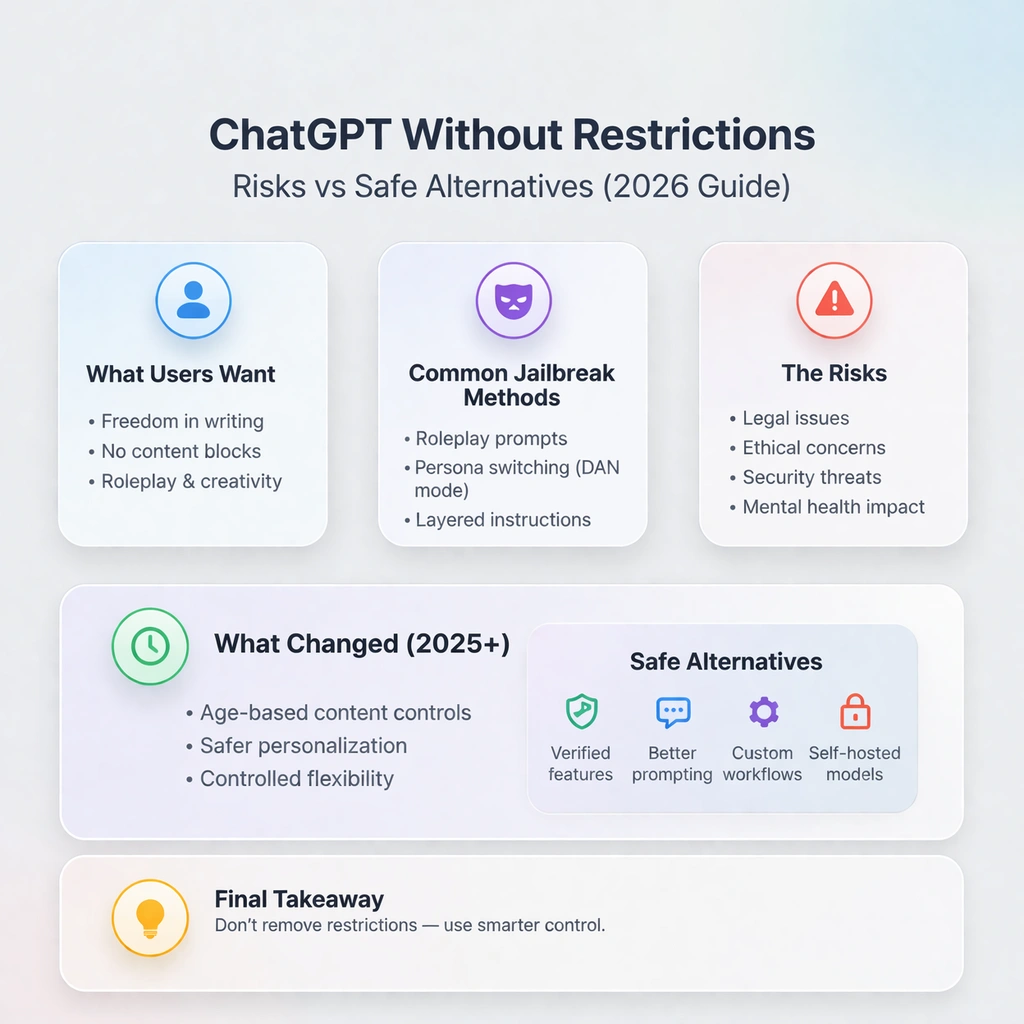
This quick infographic breaks down jailbreak myths, real risks, and smarter ways to get more freedom safely.
The Risks — Legal, Ethical, Security, and Mental Health
The risks here are not abstract. If someone uses a model to generate instructions for harm, deception, or abuse, the output can have real-world consequences. OpenAI’s usage policies prohibit things like fraud, impersonation, .exploitation of vulnerabilities, and endangering or sexualizing minors, .and the Model Spec says the assistant. should not facilitate illicit behavior or give detailed actionable steps for harmful activities. That means “unrestricted” is not just a style preference; in some contexts it becomes a safety, legal, and trust issue.
Ethically, the biggest issue is that a model can sound authoritative even when it should not be trusted. A response that feels confident can still be wrong, manipulative, or unsafe. That is why current OpenAI materials keep returning to phrases like safe, age-appropriate, transparent, and aligned. The Model Spec is trying to formalize the idea that the model should help without pretending that every request deserves the same level of freedom. It is a much more nuanced position than “block everything” or “allow everything.”
What Changed in Late 2026 and Why It Matters
One of the most important things to say here is that . the public story is more nuanced than many social posts suggest. OpenAI’s latest public Model Spec, dated October 27, 2025, says the company. is exploring ways to let developers and users generate erotica and. gore in age-appropriate contexts. through the API and ChatGPT, .while drawing a hard line against harmful uses like sexual deepfakes and revenge porn. That is not the same as removing all restrictions. It is more like acknowledging that some sensitive content may be allowed in limited contexts under the usage policy.
At the same time, OpenAI’s public usage policies and teen-safety pages .make clear that minors are treated differently, .and that the company is rolling out age prediction to better route users into the correct experience. The teen-safety blueprint states that ChatGPT is for individuals . 13 years of age and older, .describes default U18 protections, .and notes that parental controls can manage. things like memory, chat history, and blackout hours. In other words, the policy trend is not a simple relaxation. it is a more segmented system with stronger age-aware controls.
Safer Alternatives to Bypassing Filters
If your goal is legitimate, there are better paths than trying to defeat safeguards. So adult creative writing, you can usually stay within policy . by making the scene emotionally rich, atmospheric, or suggestive without asking for explicit sexual content. For research, use the official API, documented moderation settings. and controlled test prompts instead of trying to trick a consumer interface. For development teams, consider building on top of an open model you can host privately, then layer your own moderation, logging, and access controls on top of it. OpenAI’s public docs support this general direction by separating policy, model behavior, and safety protocols into distinct layers.
Another good path is simply using the platform’s customization features rather than fighting them. OpenAI’s public materials note that it invests in personalization and . custom personalities, and its collective-alignment work says it gathered input from over 1,000 people to shape model behavior more broadly. That matters because many users who want “no restrictions” really want “more voice, more control, more consistency.” Those goals are better met with configuration, prompting skill, and careful product design than with jailbreaks.
This quick infographic breaks down jailbreak myths, real risks, and smarter ways to get more freedom safely.
How to Build Responsibly with LLMs — Developer Checklist
AI developers, the real question is not .“How do I remove guardrails?”. It is “How do I build the right guardrails for my use case?”. Start by defining what content is allowed, what content is sensitive, and what content is simply off-limits. OpenAI’s Model Spec distinguishes prohibited. content, restricted content, and sensitive content in appropriate contexts,. which is a useful mental model even. if you are not using OpenAI’s stack directly. That taxonomy is more practical than a binary allowed/blocked approach, because real products are rarely binary.
Why They Work Temporarily… Then Fail (Real Example + Insight)
The biggest mistake I see teams make is treating safety as a blocklist problem. It is not. It is a product design problem, a data governance problem, and a trust problem. OpenAI’s Model Spec talks about preventing serious harm, maintaining license to operate, and using a clearly defined chain of command. That is a useful reminder that the model’s behavior is only one piece of the system. The surrounding product policy, user experience, and moderation logic matter just as much.
One thing that surprised me is how much of the modern safety conversation is about context rather than censorship. The docs allow transformation of user-provided sensitive content in certain cases, while still prohibiting new disallowed content. AI distinction is easy to miss, but it is central to how practical AI systems are actually being built. If a user already has the content, transforming it may be lower risk than generating new harmful content from scratch. That is the kind of nuance serious NLP systems need.
Real Experience / Takeaway
In real use, the best AI experiences are rarely the most “unrestricted” ones. They are the ones that feel consistent, context-aware, and honest about boundaries. A model that refuses too much becomes annoying. A model that says yes to everything becomes dangerous. The sweet spot is a system that understands intent, gives useful alternatives, and stays strict only where it truly matters. Gpt is also the direction reflected in OpenAI’s public materials: safer teen defaults, age prediction, a clearer model spec, and selective allowance of sensitive content only in limited contexts.
My honest takeaway is that “ChatGPT without restrictions” is usually the wrong goal. A better goal is “ChatGPT with the right level of control for the task.” That gives you more freedom where it is safe, more friction where it is necessary, and a better chance of getting output. you can actually use in the real world. So you are a beginner, that means learning how to frame requests better. If you are a marketer, that means using the model for ideation and drafting without pushing it into disallowed territory. If you are a developer, that means designing your own policy layer instead of outsourcing. your product decisions to a jailbreak prompt.
Who This Is Best For — and Who Should Avoid It
This topic is best for readers who want to understand the boundary between creativity and unsafe prompting. It is especially useful for beginners who keep hitting refusals,. marketers who need cleaner brainstorming flows, and developers who are building moderation-aware tools or testing model behavior. It is also useful for anyone who wants to understand how. OpenAI is thinking about age-appropriate behavior, because the public docs now make it clear that the company is building a more. differentiated system for adults and teens.
FAQs
A: Not reliably. Prompt tricks may change the model’s tone for a while, but OpenAI’s public docs describe a chain-of-command approach,. continual refinement. and safety systems designed to ignore untrusted prompt data by default. That means jailbreak-style workarounds are fragile, inconsistent, and likely to break as the system updates.
A: There can be. OpenAI’s usage policies prohibit fraud, impersonation,. exploitation, and harmful use, and the Model Spec says the assistant . should not provide detailed actionable help for illicit or dangerous activities. If someone uses AI to produce or distribute harmful instructions, the legal and ethical risk is real, not theoretical.
Final Takeaway — Stop Chasing “No Limits,” Start Using Smart Control
“ChatGPT without restrictions” sounds appealing, but the real story is more interesting than that phrase suggests. The public OpenAI docs show a system . moving toward more context-aware behavior. stronger teen protections, age prediction.clearer policy boundaries. and limited allowances for sensitive content in appropriate contexts. Restrictions is not a free-for-all, and it is not meant to be. Ai is a more selective model of freedom, .where adult users, teen users, developers, and sensitive. use cases are treated differently depending on risk and context.
