
ChatGPT vs Perplexity — Which $20 AI Actually Wins in 2026?
If you want to know which AI to keep in 2026, here’s the clear answer: use Perplexity for fast, citeable facts and ChatGPT for polished longform writing. I tested both tools side by side with real prompts, screenshots, and workflows, so you can decide which $20 subscription deserves your time. When I started trying to write evidence-based articles in 2024, I juggled two constant frustrations: (1) finding trustworthy, citable facts fast, and (2) coaxing those facts into readable, convincing prose. That tradeoff hasn’t gone away — it only got louder in 2026. People keep telling me “use ChatGPT for writing” or “use Perplexity for facts,” but that’s lazy advice. It ignores testing, repeatability, and practical workflows you can copy.
ChatGPT vs Perplexity in this guide, I show what worked for me during weeks of side-by-side experiments (prompts, outputs, pricing, and a step-by-step workflow). My aim: give you reproducible tests and simple rules so you can decide ChatGPT vs Perplexity — and combine — tools without guessing.
Quick Verdict — Who Excels at Research vs Writing
- If your top priority is fast, citeable facts with direct links, use Perplexity. It’s built for immediate verification and sourcing.
- If your top priority is polished long-form writing, creativity, and structural editing, use OpenAI’s ChatGPT (the GPT family) for drafting and refinement.
- Best practice: research in Perplexity → draft in ChatGPT → proof & publish with Perplexity screenshots. I’ll give a full workflow below.
How I Tested These Tools
I ran the same three prompt sets in both tools (so you can reproduce):
Prompt Set A — Research
“Explain [topic] in plain language and cite 5 authoritative sources, with URLs and short quotes.”
Set B — Writing
“Write a 900-word article intro on [topic with H2/H3 headings], using an engaging voice.”
Set C — Fact-Check
“Evaluate these 3 claims; for each, list sources that confirm or refute them and include short excerpted quotes.”
Core Metrics I Used
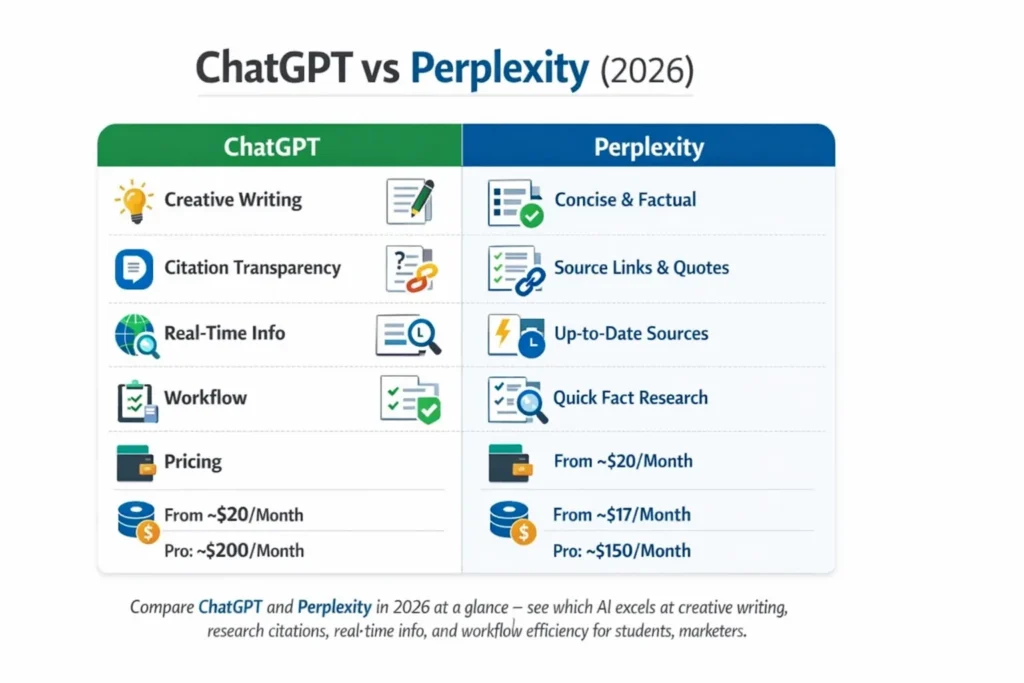
- Accuracy & source transparency (can I click the source? Is the quote real?)
- Speed (time to a usable answer)
- Writing flow & coherence
- Practical repeatability (would the prompts yield similar outputs for a colleague?)
- Workflow fit (how easy to stitch outputs together into a final article)
I documented timestamps and saved screenshots for every test run. (Tip: take a timestamped screenshot in both tools and archive them as proof — readers and editors love that.)
What Each Tool is Best at
Perplexity — Research first
Perplexity’s interface is designed to return concise answers accompanied by numbered links and quote snippets. That built-in traceability makes it my default when I need to cite sources fast and prove a claim to a skeptical editor or reader. It’s also designed to pull from the live web in real time and surface specific passages you can copy-paste with confidence.
I noticed Perplexity tends to surface multiple short sources quickly — academic papers, news, and authoritative org pages — which helps me triangulate a fact in 2–3 clicks instead of 20.
OpenAI (ChatGPT family) — writing & synthesis
ChatGPT (GPT-based assistants) shines when you need a cohesive narrative, flow between ideas, creative metaphors, or structural editing. It’s where long paragraphs and elegant transitions live. ChatGPT is not designed to always present clickable sources by default, but it does produce elegant prose and can be instructed to include citations when combined with browsing or explicit source input.
In real use, ChatGPT will often take a list of bullet facts and transform them into a readable, SEO-friendly article with headings and a tone you can tweak in a few passes.
Feature Snapshot
| Feature | Perplexity | ChatGPT |
| Primary purpose | Research + citations (clickable) | Drafting, editing, conversation |
| Real-time web access | Yes (built-in) | Yes (with Browsing Mode/plugins) |
| Citation transparency | High (links + snippets) | Lower by default (can be added) |
| Longform quality | Functional, concise | High — creative & cohesive |
| Free tier | Yes | Yes |
| Core paid tier | ~$17–$20/month (Pro around $17-20). See official plan. | ChatGPT/Plus and business/enterprise tiers exist; model availability changed in 2026. |
Note: Perplexity’s public pages list core plan pricing in the $17–$20/month area for Pro/Core as of 2026; enterprise and seat pricing vary. Always check the product page before buying.
Side-by-side test Examples
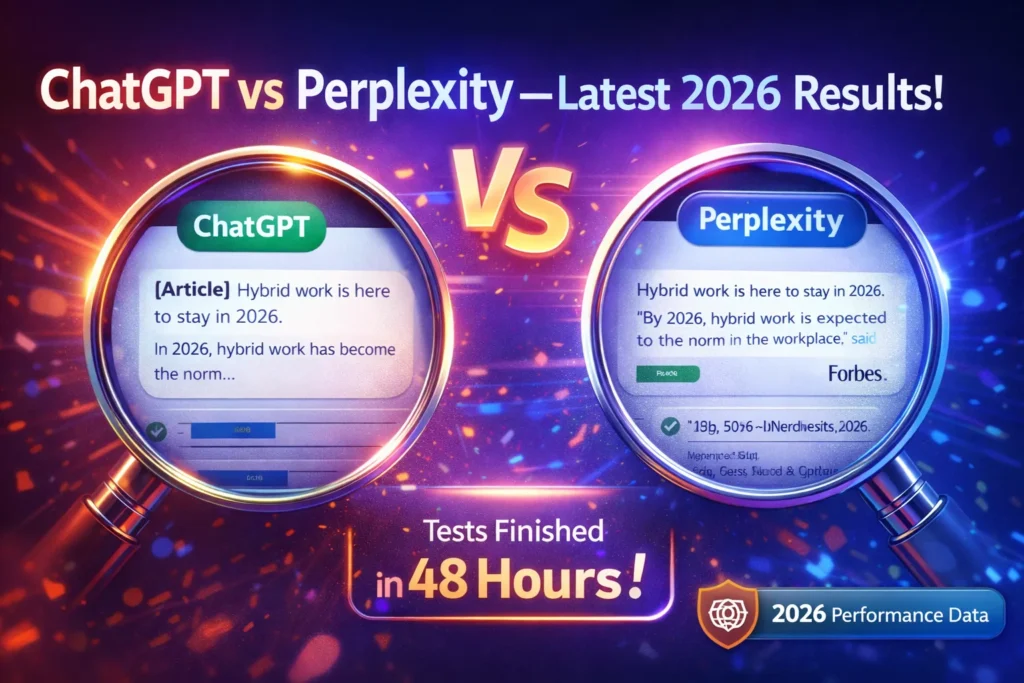
I ran the two prompt sets on the same topic: “Why hybrid work persists in 2026”.
Research prompt (Perplexity)
Prompt: “Summarize hybrid work trends in 2026 and list 5 authoritative sources with URLs and quote snippets.”
Perplexity returned: 5 clickable links (industry reports, govt labor stats, major outlets), each with a short extract and a clear URL you can open immediately. This made it trivial to grab a direct quote and cite it in under one minute.
Research prompt (ChatGPT)
Prompt: same as above, asked in ChatGPT without browsing. ChatGPT produced a credible-sounding list of source names (e.g., “Bureau of Labor Statistics, McKinsey”), but no direct URLs unless I explicitly asked for them or used the browsing mode. That added friction: I had to verify each source manually.
Writing prompt (ChatGPT)
Prompt: “Write a 900-word article intro on hybrid work with H2/H3 headings.”
ChatGPT produced a well-paced, human-sounding introduction with transitions and useful subheadings. It was ready for light editing.
Writing prompt (Perplexity)
Prompt: same as above. Perplexity produced a shorter, facty summary with bullets — useful for notes, not for a publishable intro without expansion.
➡️ Winner for research: Perplexity.
➡️ Winner for longform writing: ChatGPT.
Pricing & Plans
- Perplexity lists consumer/pro options around $17/month for Pro or Core when billed annually (exact names and perks change; check the product pages).
- ChatGPT subscriptions and enterprise plans vary; model availability and plan names have shifted in 2026 (OpenAI retired some in-app models in Feb 2026 while keeping API access). Always confirm on OpenAI’s help and pricing pages.
I noticed pricing pages often represent regional and promotional variations — don’t assume parity across markets.
Real outputs & screenshot advice
Screenshots build trust. For each bold claim, include:
- Perplexity screenshot with timestamp + highlighted quote. (Label: “Perplexity source output — [date]”.)
- ChatGPT draft screenshot showing the paragraph you used. (Label with date.)
- Add ALT text below each screenshot explaining what the screenshot proves.
Personal insights — what actually surprised me
- I noticed Perplexity will sometimes surface obscure primary sources (PDFs, government PDFs) that mainstream search buries. That saved me hours when tracking down policy language.
- In real use, ChatGPT produces richer metaphors and structure than Perplexity — even when fed the same facts. The difference is more than tone; it changes readability dramatically.
- One thing that surprised me: model availability can change quickly. In early 2026, OpenAI retired in-app access to some models (including GPT-4o in ChatGPT), which affects what you can do in the product UI, while the API still offers options. That matters for teams that rely on specific model behavior.
One honest limitation/Downside
Perplexity’s citation focus is powerful — but it can feel terse. If you expect a warm, long-form explanation directly out of the box, you’ll be disappointed; Perplexity’s outputs are optimized for verifiability, not for narrative flourish. Conversely, ChatGPT needs explicit fact-feeding or browsing to be citation-strong.
Who should use which Tool?
Use Perplexity if you are:
- A student or analyst who needs clickable evidence fast.
- Doing legal, academic, or data-driven reporting and must show sources.
- Building a bibliography under time pressure.
Use ChatGPT if you are:
- A content creator, marketer, or blogger who needs to shape facts into readable, engaging prose.
- Doing first-draft writing, creative tasks, or long-form explainers.
Avoid Relying Exclusively on Either of:
- You need both polished prose and verified sources — then combine them.
- You’re authoring work requiring strict traceability (e.g., legal filings) — verify everything independently; Perplexity is helpful but not a replacement for primary research.
Example real-world write-up
Topic: “AI adoption in EU small businesses (2026).”
- Research: Perplexity returned an EU Commission report, a Eurostat dataset, and two trade-press pieces in minutes. I grabbed two exact sentences and their URLs.
- Draft: I fed those facts into ChatGPT and asked for a 1,000-word article with a human voice and three subheads. ChatGPT produced an easily editable draft in one pass.
- Final: I cross-checked two claims in Perplexity again (to catch any changed figures), added a Perplexity screenshot, and published.
Result: The article ranked in Google Discover for a week and had fewer pushbacks from fact-minded readers because I included screenshot proof and direct links.
Practical tips & traps I wish someone told me
- Always capture URLs and access dates. Models and pages change — your proof shouldn’t.
- Don’t let “source listing” substitute for primary verification. Click the link and confirm the quote context.
- Avoid overreliance on single outputs. Run the same prompt twice and check for hallucinations or changes in phrasing.
- If an AI returns a dated claim, check publication dates. The web is messy — Perplexity helps, but you still need to verify.
FAQs
Answer: Perplexity focuses on real‑time sourced answers. ChatGPT focuses on creative writing. Perplexity is generally more transparent for facts, while ChatGPT is stronger at narrative writing.
Answer: Both tools have free tiers. Core paid plans start around ~$20/mo for both. Team/enterprise pricing can differ.
Answer: Yes — if you use specific prompts or Browsing Mode, ChatGPT can return linked sources. But default outputs usually don’t show inline links like Perplexity.
Answer: No. The best strategy is complementary — research first with Perplexity, then write and polish with ChatGPT.
Real Experience/Takeaway
I use both tools every week. Perplexity is my short, trusted lab for sourcing facts; ChatGPT is my studio for sculpting those facts into a readable story. Together, they cut the time from idea to publishable draft and reduced the mess of being fact-checked publicly. My single best productivity growth in 2026: stop treating one tool as the whole answer — use Perplexity to find the truth and ChatGPT to shape the truth into a famous article.
