
Introduction
Perplexity Max vs Leonardo Lightning XL can transform how teams create and research. In just 5 minutes, achieve faster, repeatable workflows, generating high-quality briefs or images with measurable results. Perplexity Max excels at web-grounded research, citations, and multi-step agentic automation, while Leonardo Lightning XL delivers low-latency, high-throughput image generation with consistent styles. Combine both tools to streamline content creation, marketing, or design pipelines.
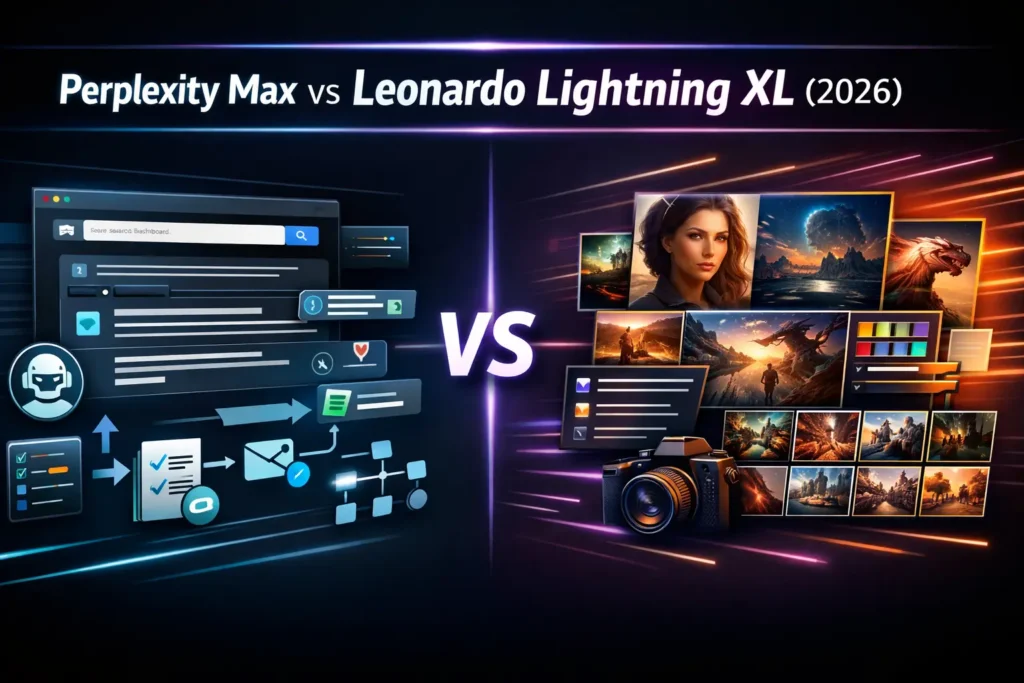
Explore reproducible prompts, cost examples, and workflow playbooks, then take action and see real results for your studio, agency, or solo projects in 2026. Use Perplexity Max when your priority is web-grounded research, citations, or agentic automation. Use Leonardo Lightning XL when your priority is fast, repeatable, high-quality image generation at scale. Combine both for the best studio/workflow ROI.
Why this Comparison Matters
AI tooling ecosystems are specializing along orthogonal axes: grounded, agentic retrieval + structured reasoning on one hand; high-throughput multimodal generation on the other. For teams that produce research-driven creative work, clarity on which tool to use at which stage of the pipeline matters for cost, reproducibility, and compliance.
From an NLP and production standpoint, Perplexity Max functions as a retrieval-augmented, agent-enabled research substrate: retrieval + citation provisioning + agent orchestration (Comet) lets you treat the web as a high-quality context for prompt-conditioned generation and automation. Leonardo Lightning XL is a latency- and throughput-optimized image model (inference-tuned variants of SDXL-like architectures) that provides deterministic-ish style control through saved parameter packages (Elements) and image-guidance. In practice, teams that pair a web-grounded research agent with a reproducible image engine shorten iteration cycles, reduce rework, and improve traceability of creative decisions, which is crucial for brand governance, compliance, and EEAT signals in publishing. This comparison unpacks product-level features, technical constraints (latency, token/credit economics, determinism), reproducible test suites, and concrete playbooks to help creators and research teams choose, combine, or benchmark these platforms.
Rapid Comparison Summary
| Category | Perplexity Max | Leonardo Lightning XL |
| Primary purpose | Research, web-grounded assistant, agentic workflows | High-throughput image generation |
| Best output | Summaries, briefs, multi-step agentic tasks with citations | High-res images, fast iterations, style variants |
| Pricing model | Subscription (Max ~ $200/mo reported) | Credits + subscription tiers; per-run costs vary by resolution |
| API | Yes — API & enterprise integrations | Yes — web UI + API; Elements & seeds help reproducibility |
| Best for | Researchers, content strategists, and teams needing automation | Visual creators, studios, and designers need many variants |
Inside Each AI: What They Really Do
What is Perplexity Max?
Perplexity Max is a premium subscription tier that unlocks higher-capability models, expanded Labs/experiment modes, and agent/browser integrations (notably the Comet assistant). Architecturally, it appears as a retrieval-augmented generation (RAG) stack combined with agent orchestration: web retrieval → citation generation → stepwise agent actions (browsing, extracting, compiling). For NLP-native users, think: retrieval index + citation metadata + an agentic policy layer that drives multi-step pipelines (Comet is the UI/agent). Primary goals: credible web grounding, traceable citations, and automation for repetitive research tasks.
What is Leonardo Lightning XL?
Leonardo Lightning XL is a finetuned, inference-optimized image model inside Leonardo.ai designed for low-latency, high-throughput image generation. Technically, it’s an optimized diffusion/transformer hybrid tuned for fast sampling and consistent style adherence when combined with “Elements” (saved parameter bundles). It supports image-guidance (reference conditioning), deterministic seeding where available, and parameterized generative controls to enable reproducible outputs at scale.
Deep dive — Perplexity Max
What it includes
- Priority access to top-capability LLMs with expanded context windows and tuned retrieval pipelines.
- Comet: an agentic browsing interface capable of scripted or semi-autonomous web navigation, extraction, and task automation.
- Labs / Research modes: iterative query exploration, versioned queries, and exportable briefing artifacts.
- Team & enterprise features: team seats, role-based access, API keys, and advanced security controls.
Strengths (what users actually get)
- Web-grounded answers with citations. Retrieval + citation metadata enables traceability and EEAT-friendly outputs.
- Agentic workflows. Comet can run multi-step tasks (e.g., visit N pages, extract X facts, synthesize a briefing), which saves manual hours in research loops.
- Iterative research modes. You can treat queries as experiments: tune prompts, capture outputs and citations, and version them for reproducibility.
Weaknesses & caveats
- Not an image studio. Perplexity focuses on information, not pixel generation. Use Leonardo or another image model for assets.
- Price/value tradeoff. Max is premium ($200/mo reported). ROI hinges on how much agentic automation you actually use.
- Vendor claims vs independent tests. Independent reproducible benchmarks (latency, automation success rate) are less common; you should publish your test artifacts.
NLP-technicals worth noting
- Retrieval quality depends on indexing recency and the retriever model (BM25 vs dense embeddings). For high-quality briefs, prefer denseretrieval + reranking.
- Comet’s agentic behavior can be seen as a policy over actions (click, extract, summarize); evaluate safety & hallucination risk by checking extracted citation anchors.
Deep dive — Leonardo Lightning XL
What it is
- Finetuned from SDXL-style backbones and tuned for inference speed and sample efficiency.
- Exposes controls for sampling steps, guidance scale, seed, and image-guidance strength.
- Elements are parameter bundles (seed + style tokens + negative prompts + sampler settings) for reproducibility.
Strengths
- Speed & throughput. Designed to produce many images quickly; suitable for batch generation workflows.
- Style flexibility. Can target photorealism, painterly, anime, and concept art via sibling mode settings.
- Reproducibility constructs. Elements + seed management + image guidance increase reliability across runs.
Weaknesses & caveats
- Credit/token costs. Per-image costs scale with resolution, sampling steps, and model selection. Heavy users must plan credits.
- Vendor claims vs independent tests. Claims about “better than X” require A/B tests using standardized metrics (FID, CLIPScore, user preference tests).
Generative-model details (NLP-adjacent)
- When pairing image generation with text prompts, treat prompts as tokens in a conditional model; minor prompt token shifts can shift latent conditioning significantly.
- Determinism is probabilistic: seed + sampler + steps -> distribution over latents. Reproducibility is non-deterministic unless the system enforces an exact RNG and runtime stack.
Direct Comparison: Features & Performance
| Feature / Metric | Perplexity Max | Leonardo Lightning XL |
| Core function | Research assistant, agentic automation | Image generation engine |
| Best output type | Summaries, briefs, web-grounded answers, agentic tasks | High-res images, variations, concept art |
| API availability | Public API & enterprise integrations | Public API & web UI; model selection & Elements |
| Speed | Fast for text; agent latency varies | Low-latency image generation; optimized for batch runs |
| Cost model | Monthly subscription (Max ~ $200/mo) | Subscription + token/credit costs; varies by plan & resolution |
| Reproducible outputs | Yes for query-based tasks (with Labs) | Yes, via saved Elements, image-guidance & seeds |
| Team features | Enterprise security & team seats | Teams, asset libraries, model options, API access |
Choosing the Right Tool for You
Solo visual creator / freelance designer
Pick: Leonardo Lightning XL. Why: style Elements, batch generation, speed. Cost: pay-per-credit models are often more economical for pure image volume.
Content strategist / technical researcher
Pick: Perplexity Max. Why: web-grounded citation support, agentic automation, and brief generation.
Small agency/studio
Pick: Both. Pipeline: Perplexity Max → Leonardo Lightning XL → QA → deliver. Use Perplexity for trend analysis and brief generation; use Leonardo for bulk creative generation.
Enterprise/compliance teams
Pick based on SLAs, security & governance: Compare Perplexity Enterprise tiers vs Leonardo team/workspace controls and ask about SOC2, contractual SLAs, data residency.
Pricing vs Performance: The True Cost
Replace prices with current vendor rates before publishing.
Freelancer: 300 images/month
Assumptions: Leonardo averages 5 credits/image, 1 credit = $0.03 (example)
Cost ≈ 300 * 5 * $0.03 = $45/month for image credits.
Perplexity Max is not necessary unless you need agentic research — $200/mo would be overkill.
Small marketing team: research + assets
Option 1: Perplexity Max ($200/mo) + Leonardo credits (vary)
Option 2: Perplexity Pro + Leonardo credits (lower subscription)
Action: publish a downloadable TCO calculator spreadsheet where readers plug in the images/month, hours saved, number of team seats, and current prices.
From Research to Creation: Workflow Maps
Creative campaign (fast iteration)
- Perplexity Max: run trend analysis and compile a 1-page brief with keywords, tone, and references.
- Export brief and reference images (from URLs or screenshots).
- Leonardo Lightning XL: run batch generations (50 concepts) using Elements to lock style.
- Internal review: annotate tothe p 10 images. Use image-guidance to refine.
- Export with metadata (prompts, seeds, credits used) for traceability.
Research → creative handoff
- Perplexity: produce annotated links, sample captions, and moodboard text. Export annotated PDF.
- Leonardo: import references and run guided generation with Elements.
- Human QA: brand, legal checks, and metadata verification.
Automated outreach with images
- Perplexity Max: agent drafts personalized outreach messages using CRM fields.
- Leonardo: generate personalized image variants (A/B) for prospects.
- Manual QA & send.
Pros & Cons
Perplexity Max
Pros: Web-grounded with citations; agentic tools; good for multi-step research.
Cons: High-tier price; not for image generation.
Leonardo Lightning XL
Pros: Low-latency, high-throughput; Elements for reproducibility; flexible styles.
Cons: Credits add up; vendor claims should be verified via A/B testing.
FAQs
No. Perplexity Max is mainly a research and productivity subscription that offers web-grounded answers and agentic tools (Comet). Use Leonardo Lightning XL for image production.
Perplexity lists Max at approximately $200/month (reportedly). Confirm current pricing on Perplexity’s pricing page before publishing.
Vendor claims emphasize speed and throughput. The safe approach: run independent A/B tests (use the reproducible prompts above) and report metrics (preference testing, CLIPScore, FID, latency).
Yes, in principle. Perplexity Max can draft messages and briefs; Leonardo can produce images. Always insert human QA for legal/brand safety.
Final verdict & recommended next steps
They solve different problems. Use Perplexity Max for trusted, web-grounded research and agent automation. Use Leonardo Lightning XL for fast, reproducible image production. Most teams get the most ROI by combining both: research & briefs from Perplexity → batch image production in Leonardo → QA → publish.
Recommended next steps:
- Run the reproducible prompts and publish raw data (prompts, seeds, credits).
- Create a TCO calculator and publish it as a downloadable sheet.
- Build a canonical pipeline doc that maps Perplexity outputs (briefs, links) to Leonardo Elements and assets.
- Run A/B tests and publish metrics (latency, credit cost, user preference).
