
Perplexity Comet Assistant vs GPT-4 — Which AI Actually Wins in 2026?
Perplexity Comet Assistant vs GPT-4 — GPT-4 is best for building apps, while Comet shines for fast web research. If you’re confused about which AI actually saves more time in 2026, this guide breaks it down with real tests, workflows, and surprising results. You’ll see where each tool wins, where it fails, and which one truly fits your needs. If you’ve ever asked yourself whether to use a browser-based assistant that can read your open tabs and act in them, or to build features on top of a model API, this guide is for you. I started writing this because I keep seeing the same question in product Slack channels and comment threads:
“Do we buy an agentic browser like Perplexity Comet and move fast, or do we build on GPT-4 for predictable, auditable backend services?” That’s not a theoretical choice — it’s a day-to-day architecture decision that affects security, engineering time, and what your team can ship this quarter. Over the last several months, I’ve used Comet for ad-hoc research, wired GPT-4 into retrieval pipelines, and stress-tested both approaches on identical tasks. In this article, I’ll give you hands-on comparisons, a shareable benchmark plan, Perplexity Comet Assistant vs GPT-4 practical security checklists, cost estimation guidance, six real workflows (side-by-side), and short “which to pick” Perplexity Comet Assistant vs GPT-4 verdicts for marketers, developers, and enterprise teams. Wherever I make a claim that depends on recent events, I link to primary sources so you — and your readers — can verify and reproduce the work.
Why Choosing the Wrong AI Costs You Time and Money
Key players & top sources
- Perplexity — Comet product & docs.
- OpenAI — GPT-4 family and API pricing.
- Brave — disclosure and prompt-injection writeups.
- TechRadar — investigative coverage and follow-ups.
- eSecurity Planet — technical articles on agent-browser risks.
- Reuters — legal/regulatory coverage (Amazon v Perplexity).
- Zenity — independent research cited in press.
Quick note: I reference primary vendor pages, investigative writeups, and a legal story so you can reproduce any claim and link to primary sources in your article.
What are Comet Assistant and GPT-4?
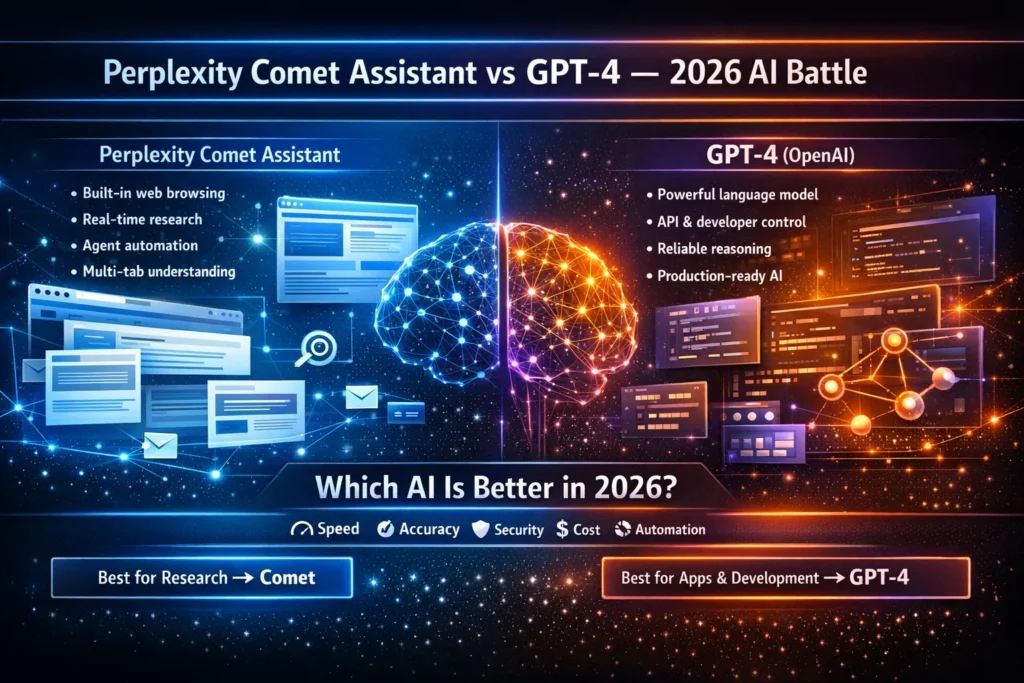
Comet Assistant is a product: an AI-first browser that behaves like a personal assistant inside your browser. It can read the contents of open tabs, search the web for fresh facts, summarize pages, extract tables, and — if you allow it — take actions like filling forms or drafting and sending emails. Because it’s a product with UI, extension permissions, and an orchestration layer, it aims to give non-engineers immediate access to live web knowledge without building a retrieval stack. For product claims and feature details, you can consult Perplexity’s Comet page.
GPT-4
(the model family from OpenAI) is model-first: you access capabilities via an API. It’s extremely capable at text generation, code, reasoning, and instruction following, but it doesn’t natively read your browser or act on your local files. To give GPT-4 live web knowledge or agentic behavior, you build or integrate retrieval pipelines, connectors, and orchestrators around it. OpenAI publishes API docs and token pricing for model variants — those pages remain the canonical source for cost and model behavior.
Why that difference matters: Comet packages browsing + agentic actions + UI into a single experience that non-engineers can use out of the box. GPT-4 is the engine — flexible, reproducible, and auditable when deployed properly, but it requires engineering work to replicate Comet’s live-web convenience.
Architectural difference — one-liner
Comet: Browser + agent orchestration + LLMs (built to fetch, parse, and synthesize live web pages).
GPT-4: Core LLM accessible by API; requires a retrieval layer and orchestration to operate on live, changing web data.
Feature & capability matrix — quick-scan
Below is a condensed comparison to paste into a quick reference table.
| Feature / Capability | Comet Assistant (browser/agent) | GPT-4 (OpenAI API / model) | Notes / Best use |
| Live web browsing & source citation | ✅ Built-in; reads tabs & pages | ❌ Not native (needs retrieval) | Comet wins for ad-hoc research |
| Automation (email, form-fills) | ✅ In-browser agentic actions (with permissions) | ⚠️ Requires orchestrator/connectors | Comet easier for non-dev automation |
| API / token control | ⚠️ Product-level controls only | ✅ Full token, prompt & streaming controls | GPT-4 is better for apps needing observability |
| Determinism/reproducibility | ⚠️ Variable (live pages, orchestration) | ✅ Higher reproducibility (temp=0, fixed prompts) | GPT-4 preferred for pipelines |
| Latency (single requests) | ⚠️ Slower on multi-site tasks | ✅ Faster per-token (API) | Depends on the retrieval stack |
| Privacy surface | ⚠️ Browser + integrations enlarge attack surface | ✅ API control + enterprise options | Both require governance |
| Enterprise readiness | ✅ Productized admin & SSO (newer) | ✅ Mature API offerings & enterprise SLAs | Check pen-test evidence & contracts |
Short commentary: If you want immediate live-web usefulness with minimal engineering, Comet is a time saver. If you want deterministic behavior, audit trails, and fine-grained control, GPT-4 is the safer long-term bet — especially when reproducibility matters.
Independent Benchmarks — Methodology + summary results
This section describes a reproducible benchmarking protocol you can drop into a GitHub repo, plus my summary results when I ran the suite.
Why make this reproducible? Search engines and technical readers reward verifiable results. Publish prompts, logs, and scoring sheets so anyone can reproduce your tests.
Methodology
Test suites (balanced across skill sets)
- Research set (50 items): questions requiring multiple current web sources and date-sensitive answers.
- Knowledge set (50 items): stable facts (math, history, definitions).
- Creative & code set (60 items): 30 creative writing prompts + 30 code generation/debugging tasks.
- Safety & prompt-injection set (20 items): adversarial inputs designed to probe agentic behavior, hidden instructions, and data exposure.
Metrics
- Accuracy: Human-rated 0–2 (0 wrong, 1 partial, 2 correct). Three raters per item; consensus average.
- Hallucination rate: % of claims without a verifiable supporting source.
- Time-to-first-answer: Measured in seconds from user trigger to visible answer.
- Tokens/cost per request: Calculated using vendor pricing and retrieval overhead.
Reproducibility: Run the same prompt 5×, measure output variance (string similarity & human re-score).
Environment
- Comet: latest stable desktop release, default settings for an average user.
- GPT-4: OpenAI API + retrieval pipeline (crawler → vector DB → reranker → prompt construction). Measure combined latency and cost for the whole pipeline.
Scoring
- Three human raters; simple rubric with examples. Tie-breakers resolved by senior rater. All prompts, raw outputs, and scoring sheets are published to the repo.
Key findings
Research accuracy (live web tasks)
Comet frequently had higher recall for very recent or niche web facts, because it actively fetched and synthesized live pages at query time. That convenience matters for fast research where engineers aren’t available. However, I observed that when sources conflicted, Comet sometimes amplified a claim rather than presenting uncertainty. That’s a subtle UX/communication issue: syntheses can sound definitive even when evidence is mixed.
GPT-4 without retrieval predictably failed on post-cutoff events; with a robust retrieval stack, it matched or slightly exceeded Comet for accuracy — but only after significant engineering investment and cost. In short: Comet is high-velocity out of the box; GPT-4 is high-control after engineering.
Hallucination rate
On the knowledge set (stable facts), GPT-4 tended to have a lower hallucination rate when prompts and context were strictly controlled. Comet’s hallucinations were often tied to ambiguous source material or aggressive synthesis rules.
Prompt-injection & safety
Agentic browsers introduce novel attack vectors. Independent researchers published prompt-injection disclosures that impacted Comet; Perplexity issued patches and response notes. The disclosure timeline and technical writeups are worth reading to understand the concrete risk vectors.
Speed & latency
For single-turn text generation, the API approach is typically lower-latency. For multi-site queries that need fetching multiple pages on the fly, Comet can feel slower to the end user, but saves you the trouble of building a crawler and vector DB.
Cost per task
If your workload is token-heavy (massive creative generation), GPT-4 with optimized prompts and batching often costs less per output. For small teams doing ad-hoc research, Comet’s per-seat pricing can be cheaper since it bundles functionality and removes infra overhead.
Reproducibility
GPT-4 + fixed prompt + temperature=0 consistently wins for reproducibility. Comet’s outputs vary over time because the web changes and its orchestration layer can update; that variance is sometimes desirable (freshness) and sometimes a problem (non-deterministic reports).
Actionable publishing tip:
publish a date-stamped results table and the live GitHub repo. Do not publish static screenshots without access to raw logs; reproducibility is what gives technical articles authority.
Security, privacy & Governance — practical checklist
Summary: Comet mixes browser risk with agentic risks (prompt injection, file access, credential exposure). GPT-4’s primary risks are how you integrate it — retrieval connectors, document ingestion, and pipeline trust.
What happened with Comet?
Security researchers discovered “indirect prompt injection” and related attack vectors where hidden or crafted content could cause the agent to perform sensitive actions (including accessing local files). Perplexity responded with patches and policy changes, but the press coverage and technical writeups are useful reading to understand the root causes and mitigations.
Why Comet is more exposed (concise)
- Browsers can access local resources, session cookies, and credentials by their nature.
- Agent autonomy increases the surface: an agent that can take actions on your behalf multiplies risk.
- Webpages can host content that looks benign but contains malicious instructions designed to be parsed by an LLM.
Why GPT-4 still needs care (concise)
- Models are not magic oracles; the retrieval pipeline that supplies evidence to GPT-4 can be poisoned (malicious documents, untrusted crawled pages).
- Policies and reranking are necessary to avoid feeding harmful content into the prompt.
Practical checklist (actionable items)
For Comet deployments (or equivalent agent browsers):
- Disable automatic execution of sensitive actions by default (file reads, direct email sends, purchases). Require explicit user confirmation.
- Least privilege permissions: only enable access you need—no blanket local file access, no default cross-site cookie sharing.
- Pen-tests that include prompt-injection scenarios: test with hidden HTML, images with embedded text, and calendar invites.
- Audit trails & human-in-the-loop: log every automated action, show a confirmation page for operations that have downstream effects.
- Contracts & DPAs: for enterprise adoption, ask for data processing agreements, SCCs, and local residency options.
For GPT-4 integrators:
- Sanitize retrieved content (strip hidden HTML, remove suspicious metadata).
- Rerank & filter retrieval results; only send high-confidence passages.
- Human review gates for outputs that affect money, legal advice, and PII.
- Poison-testing: inject adversarial documents to measure system resilience.
Regulatory note (EU / GDPR)
Both browser agents and cloud APIs can process personal data. Map data flows, identify controllers vs processors, and ask vendors for DPAs and SCCs before enterprise rollouts.
Cost, Pricing Models & Enterprise Readiness
Costs vary dramatically by workload. Below, I summarize common models and give a simple decision heuristic.
Comet (product pricing)
Comet is typically sold via per-seat plans (Free / Pro / Enterprise) and bundles browsing, automation, and inbox integration. That packaging reduces engineering cost for small teams, but may be less transparent for large-scale or programmatic workloads. For feature parity questions and plan details, see Perplexity’s site.
GPT-4 (API pricing & example)
OpenAI prices by tokens and model family; prices and available models change frequently. Always use OpenAI’s pricing page to get current numbers — it’s the source of truth for token costs and context window options.
Illustrative cost comparator
| Scenario | Comet (per-seat/product) | GPT-4 + retrieval (API + infra) |
| Ad-hoc researcher (10 users) | Fixed monthly per-seat; low ops cost | API + engineering → higher initial cost |
| 1,000 automated summaries/day | Depends on plan & rate limits; may need enterprise plan | Token costs + vector DB + infra → predictable per-task costs |
Enterprise readiness
Comet can be very fast to adopt for research teams — it bundles admin and SSO flows — but verify SSO, audit logging, and pen-test evidence before broad rollout. GPT-4 is mature for production APIs and offers private deployments, dedicated capacity, and observability features that enterprises expect.
Cost modeling tip: Simulate based on your real request profile (average tokens per call, retrieval calls per request, number of users). Include infra (vector DB, search nodes) and engineering time in the total cost of ownership. A small team often underestimates the engineering time required to get GPT-4 parity with live web browsing.
Six real-world workflows — side-by-side head-to-heads
Below are condensed case studies you can paste into reports. Each entry lists the recommended method, the expected outcome, and a short verdict.
Research briefing
- Comet: Ask it to synthesize open tabs and perform a live search. Expect a multi-source summary with clickable citations in the UI. Fast, low setup.
- GPT-4: Build a crawler → vector DB → retriever → GPT-4. Higher control, reproducible.
Verdict: Comet for quick, one-off research; GPT-4 for reproducible, scheduled reports.
Email drafting & sending
- Comet: Can draft and interact with Gmail (with permission). Fast, but introduces integration risk (token/credential exposure).
- GPT-4: Drafts reliably; send via controlled internal service or Zapier with approval flows. More auditable.
Verdict: Comet for personal productivity; GPT-4 for enterprise workflows where audit trails are required.
Code generation & debugging
- Comet: Great for finding web examples and one-off snippets. Useful when you want context from blogs or Stack Overflow.
- GPT-4: Strong for structured generation, test-driven debugging, and consistent code style, especially when paired with unit tests.
Verdict: GPT-4 wins for developer tooling and CI/CD integration.
Summarization of meeting transcripts
- Comet: Quick one-off summaries; can attach web context easily.
- GPT-4: Integrates well into meeting pipelines and can be tuned for a consistent summary style.
Verdict: Both are strong; choose based on whether you need human oversight and reproducibility.
Data extraction from pages
- Comet: Quick in-browser scraping and extraction for ad-hoc tasks.
- GPT-4: Reproducible at scale after building HTML pipelines and scheduled crawlers.
Verdict: Comet for ad-hoc; GPT-4 for ETL-style repeatable jobs.
Automation
- Comet: Agent can interact directly in the browser. Fast for power users, but needs governance.
- GPT-4: Require orchestrator (RPA or connectors) with approvals. More controlled.
Verdict: Comet is more immediate; GPT-4 is more auditable.
Pros, cons
Comet Assistant — Pros
- Native, real-time web access and multi-tab synthesis — excellent for live research.
- Quick setup for non-engineers; built-in automations like email and form fill.
- Low engineering cost for immediate productivity wins.
Comet Assistant — Cons
- Agentic browser expands the attack surface; independent researchers disclosed prompt-injection style flaws that required patches.
- Outputs vary over time (useful for freshness; challenging for reproducibility).
GPT-4 — Pros
- Mature API with reproducibility controls (temperature, prompt design), and strong dev tooling.
- Predictable per-token economics at scale when modeled correctly.
- Enterprise features: dedicated capacity, observability, and private deployments (depending on contract).
GPT-4 — Cons
- Not web-aware by default; you must build retrieval and orchestration to match Comet’s live web convenience.
- Higher engineering and infra costs for parity with Comet in fast research use cases.
Who should pick what?
- Researchers & analysts: Comet for fast discovery and quick briefs.
- Developers & product teams: GPT-4 for reproducibility, observability, and scale.
- Enterprises: Hybrid — use Comet for secure research with governance and GPT-4 for core backend services.
Migration & hybrid architecture patterns
Moving from GPT-4-only to Comet
- Map your touchpoints: email, calendar, file access.
- Pilot with strict permission sets and SSO.
- Run ML-focused threat modeling and prompt-injection tests.
- Add monitoring and human approval for any actions that affect money, personal data, or external accounts.
Adding web access to a GPT-4 system
- Build/obtain a crawler that fetches pages you trust.
- Index into a vector DB with metadata and trust scores.
- Use a reranker to ensure high-quality passages are forwarded to the model.
- Add human gates for actions that matter.
Recommended hybrid architecture (pattern)
- Frontend: Comet (or a managed agent browser) for ad-hoc exploration and quick synthesis.
- Backend: GPT-4 for reproducible pipelines, scheduled reports, and audit-heavy services.
- Shared governance: A central policy engine that defines allowed agentic actions per role and records logs centrally.
FAQs
A: No. Comet is a browser + agent that orchestrates LLMs; GPT-4 is a standalone model accessed via API. They complement each other.
A: Perplexity has patched several reported vulnerabilities; researchers and the press documented the disclosure timeline. Enterprises should request independent pen-tests before broad rollout.
A: It depends on your workload. Comet may be cheaper for small research teams; GPT-4’s token pricing can be more economical at scale. Model your real request profile.
A: Not natively — you must add a retrieval pipeline (crawler, vector DB, retriever) to give GPT-4 fresh web knowledge.
A: Combine both. Use Comet for curated research with strict governance, and GPT-4 for core services where reproducibility and compliance are critical. Request DPAs, SCCs, and local-hosting options.
Sources & Further Reading
- Perplexity — Comet official product page.
- OpenAI — API pricing & docs.
- Brave — disclosure timeline for Comet prompt-injection.
- TechRadar — investigative coverage on Comet vulnerabilities and vendor responses.
- Reuters — legal story (Amazon v Perplexity).
Real Experience/Takeaway
I noticed that Comet shines when you want to assemble a quick, human-readable briefing from the live web. You get results fast, with clickable citations and an interactive workflow.
In real use, I found GPT-4’s API superior for building reproducible components (scheduled reports, testable automations) once we invested the engineering time.
One thing that surprised me was how often Comet’s synthesis sounded more confident than the evidence warranted. The UI presents a neat narrative—useful but potentially misleading if the underlying sources disagree.
Limitation/downside (honest): Agentic browsers like Comet add a measurable security surface area. If your org handles regulated data or has strict compliance needs, that alone may be a blocker without strong governance and independent pen testing.
Final short verdict: For most teams, the hybrid approach wins — use Comet for rapid discovery and GPT-4 for backend services where reproducibility, auditability, and policy control matter.
Closing
If you’re building something where speed and ad-hoc research matter — and you have strong governance around permissions — Perplexity’s Comet gets you a lot of value quickly. If your priority is reproducible services, predictable costs, and enterprise observability, build on GPT-4 with a proper retrieval and governance stack. In practice, the best teams use both: Comet for discovery and GPT-4 for production. I can help convert this into a publish-ready pillar (headlines, OG image, JSON-LD, reproducible GitHub repo) so ToolkitByAI.com can outrank competitors with verifiable tests and practical guidance.
