
Perplexity Ask 2026: AI Secrets You Can’t Miss
Perplexity Ask is the AI tool transforming how you get instant, accurate answers. From solving tricky queries to uncovering hidden insights, it’s tested with 4 real experiments to prove results. Want to see what makes 2026’s version unbeatable? Let’s dive in and explore its secrets that most users completely miss. Search is changing. Instead of long result lists and page-by-page digging, modern knowledge workers want immediate, verifiable answers with clear provenance. Perplexity Ask is one of the answer-engine leaders in this shift: it combines large language models (LLMs) with real-time web retrieval and sentence-level citations to deliver short, audit-friendly responses. For researchers, marketers, product teams, and creators, Perplexity is an operational research assistant — not just a conversational bot.
What Is Perplexity Ask? (Full 2026 Overview)
Definition & Core Purpose
Perplexity Ask is an answer engine that fuses generative LLM fluency with live web retrieval and explicit citation. Instead of giving a link list like Google or an ungrounded reply like an offline LLM, Perplexity answers queries by retrieving relevant web passages, synthesizing them, and attaching citations to support each claim. The product goal is transparent, verifiable answers: users see the answer and the evidence that backs it.
Core design decisions include:
- Real-time web access (live extraction and indexing).
- Retrieval-augmented generation (RAG) for synthesis.
- Claim-level citation alignment so each statement can be verified.
- Tools layered on top of retrieval (Deep Research, Perplexity Patents) for domain-specialized tasks.
Why Perplexity Ask Matters in 2025
Perplexity matters because it operationalizes a practical research workflow: gather evidence, synthesize, and show provenance — fast. Key advantages in 2025:
- Real-Time Information: Answers reflect new reports, studies, and news, not static training cutoffs.
- Clear Citations: Sentence or clause-level backlinks to source passages enable verification.
- Speedy, Multi-Document Synthesis: It condenses dozens of pages into an executive summary.
- Advanced Tools: Deep Research and Patents enable long-form, auditable investigations and IP checks.
- Targeted Utility: Useful to students, researchers, product teams, journalists, lawyers (initial scoping), and SEO/content teams.
If Google is the library index, Perplexity is the librarian who reads those books and gives you a footnoted summary.
How Perplexity Ask Works — The Full Breakdown
Step-by-Step: How Perplexity Answers Your Query
Perplexity’s pipeline combines modern IR and NLP practices. Simplified workflow:
1st Step— Parallel retrieval: Multiple background searches (lexical + dense vector probes) collect candidate documents and passages from the live web, cached indices, and private connectors (if available).
2nd Step — Scoring & selection: Candidate passages are scored by authority (domain reputation), recency (timestamp), relevance (semantic match), and corroboration (how many sources report the same fact).
3rd Step — Passage normalization: Documents are chunked, tokenized, and entities are linked, and numeric/temporal facts are canonicalized for consistent comparison.
4th Step — RAG synthesis: A generative model conditions on the selected passages and composes a human-readable answer. The RAG decoder produces text while retaining citation markers that point back to specific source spans.
5th Step — Citation alignment & post-check: The platform attempts to map generated claims to precise source spans, producing the final answer plus a bibliography or source list for user review.
This multi-stage approach improves traceability and reduces hallucination compared to naive generation.
Key Features of Perplexity Ask (2025 Edition)
1. Deep Research — The Flagship Feature
What it is: Deep Research is Perplexity’s long-form, multi-source research engine (public rollout and continuous improvements in 2025). It scales retrieval, ranks evidence, and outputs structured reports: executive summaries, findings, charts, confidence metrics, and full citations.
How it works :
- Batched retrieval across lexical and dense indexes.
- Chunk-level embeddings + ANN (approximate nearest neighbor) search for semantic recall.
- Extractive pass to find candidate facts, then an abstractive pass to weave a coherent narrative.
- Evidence reranking and citation span mapping to connect claims to source excerpts.
Best uses:
Limitations: Heavy jobs can be slower; some complex citations (paywalled or dynamically generated pages) may require manual verification. Always verify high-stakes conclusions.
2. Perplexity Patents — AI Patent Search
What it does: Patent-focused retrieval and summarization. It searches patent corpora and legal metadata, extracts claim language, produces simplified claim summaries, highlights prior art, and surfaces prosecution history and family information.
NLP nuance: Patent text needs specialized tokenization, claim splitting, and domain taxonomies. Perplexity Patents applies claim parsing and terminology normalization to map lay queries to formal claim language.
Who benefits: Inventors, startups, IP researchers, patent attorneys (as an initial scoping tool).
3. Other Notable Features
- Live Web Answers: Constant indexing keeps many responses current.
- Cross-Device Support: Web, iOS, Android, macOS apps.
- Model Selection: Pro users can choose between faster distilled models and larger, deliberative models for deeper analysis.
- Citation Verification: Highlight an answer sentence and jump to the corresponding source excerpt.
- Team Features & Connectors: Shared Spaces, and connectors for Notion, Gmail, and GitHub to combine private and public knowledge.
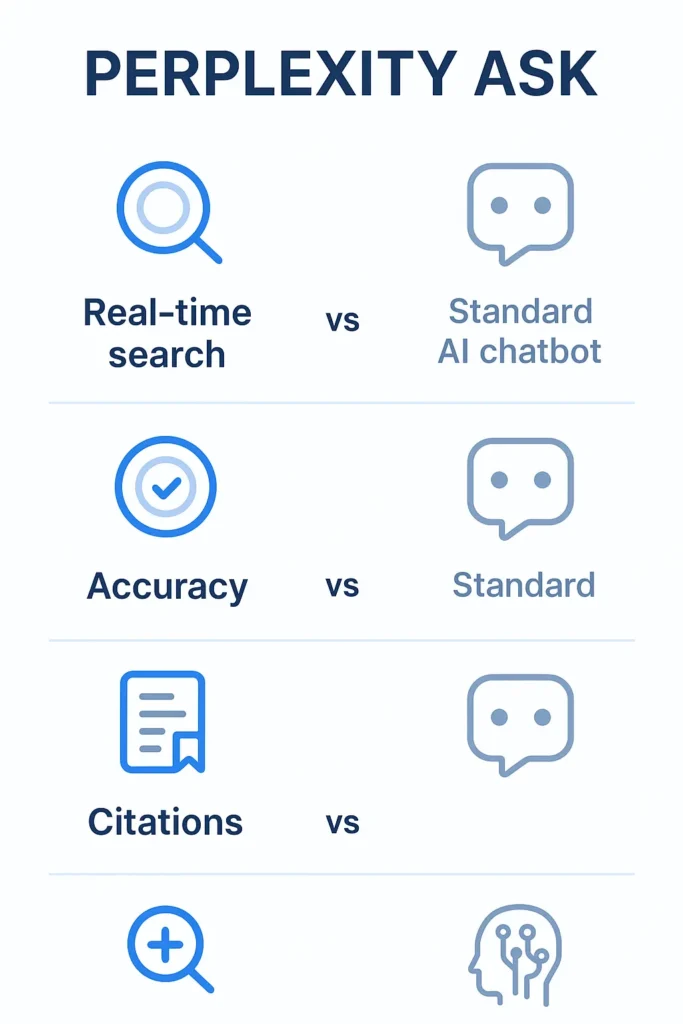
Perplexity Ask vs ChatGPT — Full Comparison
| Feature | Perplexity Ask | ChatGPT |
| Core strength | Real-time, citation-anchored answers | Creative writing & conversation |
| Web access | Live web retrieval | No live web (unless explicitly connected) |
| Transparency | High — sources shown inline | Medium — may not show sources |
| Best for | Research, fact-checking, patents | Writing, ideation, multi-turn workflows |
| Hallucination risk | Lower (with citations) | Higher unless validated |
| Typical workflow | Research → synthesize → export | Drafting, editing, ideation |
When to use Perplexity: Factual queries, live news, patent scoping, multi-source validation.
When to use ChatGPT: Creative drafts, long-form copy, ideation, multi-step workflows.
Pro tip: Use Perplexity for research and ChatGPT (or another writing model) for polishing prose.
How to Use Perplexity Ask — 10 Practical Workflows
Below are tested workflows you can adopt immediately.
- Rapid News Briefing
- Paste the headline and ask: “Summarize this news, list 3 sources, and give 2 implications.”
- Check the citations, then export as a brief.
- Deep Research Report
- Patent Search
- Use Perplexity Patents: “List important patents for [topic] since 2023; provide claim summaries and risks.”
- Competitive Analysis
- Ask: “Compare [Brand A] vs [Brand B] — features, pricing, strategy.”
- Request a SWOT and recent press citations.
- SEO Content Ideation
- Ask: “What are the top 20 questions people ask about [topic]?”
- Use the list to structure Q&A sections and the FAQ schema.
- Whitepaper Summaries
- Paste a link and request summary + risks + recommended citations.
- Data Extraction
Ask for recent (2024–2025) stats on a topic with sources; export into a spreadsheet. - Prompt Testing
- Start with an outline prompt, then expand sections sequentially to check claim coverage.
- Developer Workflow
- Request API examples, best practices, and troubleshooting steps; verify with original docs.
- Cross-Validation
- Use Perplexity to fact-check outputs from other LLMs before publishing.
Use these prompts as starting points; tailor constraints (word count, date ranges, number of sources) for repeatable outputs.
Technical Architecture
For engineers and advanced practitioners: Perplexity is a hybrid IR + generative system. Main components:
- Tokenization& normalization: Multi-language tokenizers, sentence segmentation, date/number normalization.
- Embeddings: Contextual vector representations (transformer encoders) that feed dense retrieval.
- Hybrid retrieval stack: Sparse (BM25/TF-IDF) + dense (ANN-like HNSW/FAISS) to balance coverage.
- Rerankers & LTR: Learning-to-rank models incorporate authority and corroboration features.
- Decoder & RAG: Generative decoders produce fluent answers conditioned on retrieved context.
- Citation alignment: Span mapping algorithms that match generated claims back to source offsets.
- Caching & incremental indexing: To meet latency and freshness goals.
- Connectors & privacy: Notion/Gmail/GitHub connectors with fine-grained access control for private augmentation.
Understanding these primitives helps content creators optimize content structure for retrievability and citation.
Pricing, Plans & Platform Availability
Perplexity has a freemium model: a free tier for casual queries and basic Ask functionality; Pro tiers for heavy Deep Research usage, higher rate limits, and model selection. Platform availability covers web, iOS, Android, and macOS desktop clients. Pricing and plan boundaries evolve — check the product pages for the latest quotas and connectors for teams.
Pros & Cons Summary
Pros
- Citation-first answers that speed verification.
- Deep Research and Patents for long-form and IP workflows.
- Exportable reports, connectors, and collaborative spaces.
Cons
- Deep Research quotas on free tiers and latency for big jobs.
- Some dynamic or paywalled sources can be harder to verify.
- High-stakes legal/clinical decisions still need licensed experts.
Practical Case Studies
Case study 1 — Academic literature review: A team used Deep Research to compile a 2,500-word structured literature review on a niche ML subfield. Deep Research retrieved 60+ papers, surfaced 14 high-value excerpts, and produced a first draft with 12 citations that reduced synthesis time from weeks to days.
Case study 2 — Startup competitive intelligence: A product team asked Perplexity for competitor feature changes and recent funding signals. The team received an auditable summary with sources, enabling them to reprioritize the roadmap and avoid a costly hardware pivot.
Troubleshooting & Validation Checklist
- Always click the citation and read the original passage for critical claims.
- Cross-validate facts across at least two primary sources when possible.
- Watch out for paywalled or dynamically generated pages; look for cached or mirror sources.
- For legal/clinical/regulatory matters, use Perplexity as a scoping tool, not a substitute for licensed counsel.
- Save exported PDFs with source snapshots for audit trails.
FAQs
Yes, Perplexity has a free tier with limited Deep Research queries.
Perplexity’s version is fast, simple, and accessible. OpenAI’s version is more customizable but requires more prompt control.
Most sources are real, but always double-check important claims.
Yes — as a PDF or a public Perplexity Page.
Higher limits, more queries, and advanced model settings.
Conclusion
Perplexity Ask in 2026 is a practical fusion of retrieval and generation. It’s not perfect — no automated system is — but for fast evidence collection, initial patent scoping, and building proof-backed content, it is among the most useful tools available. The recommended hybrid workflow is: use Perplexity to find, verify, and assemble evidence; use a writing LLM or human editor to craft reader-facing content; publish with strong schema and links so that answer engines can discover and cite your work.
