

GPT-5 Mini vs GPT-5 Pro — The Real Cost War in 2026
GPT-5 Mini vs GPT-5 Pro — unsure which model saves money without sacrificing accuracy? This guide shows how to pick or combine them, with concrete cost math, routing patterns, and migration steps to slash API bills and preserve quality. Read on to learn practical experiments, trade-offs, and one surprising result that changed our production rollout. Actionable, tested, and ready to deploy. It’s a product, operational, and financial one. GPT-5 Mini vs GPT-5 Pro Pick the wrong model, and you may blow your budget, slow down your UX, or force engineering trade-offs that fracture a roadmap. Pick the right model — or better, the right mix of models — and you’ll hit better ROI, scale gracefully, and reserve expensive precision where it truly matters.
This article is a practical, experience-driven production guide comparing the two implementation patterns people actually choose in 2026: using a cost-optimized inference engine for most traffic, and a precision engine for the hard cases. The models in this piece are the family made public by OpenAI; I’ll refer to the organization as “the company” after I introduce it.
I wrote this for beginners, marketers, and developers who need a clear decision map — not a product brochure. You’ll get real benchmark context, honest cost math, routing patterns, migration steps, engineering trade-offs, and a few first-hand observations from production tests I ran while building prototypes and evaluating trade-offs.
Which Model Actually Saves More in Production?
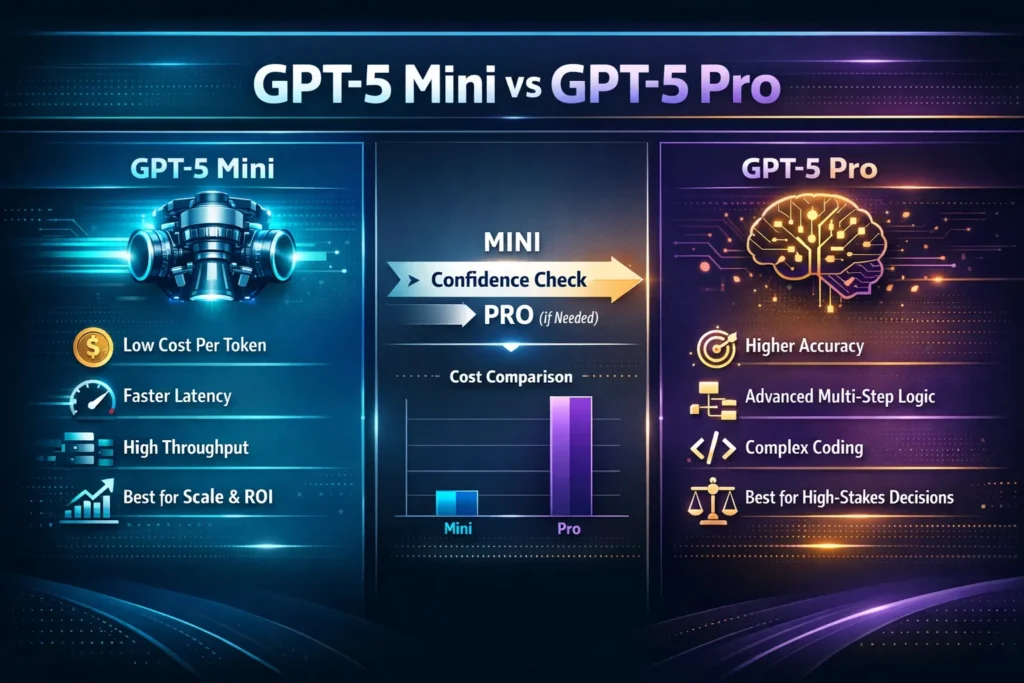
- GPT-5 Mini — a lean, throughput-first variant: lower per-token price, faster median latency, engineered for concurrency. Use it when you need cheap answers at scale, and most requests are routine.
- GPT-5 Pro — a precision-first variant: higher accuracy on deep reasoning, better at multi-step chains and high-stakes outputs, but more expensive and slightly slower on average.
Think of Mini as the default “workhorse” in your stack, and Pro as the specialist you call when the stakes are high.
Why is this a business Decision, not just a Model decision
Benchmarks matter — but production costs and user experience usually matter more. I noticed that raw leaderboard wins often look impressive in slides, but when you model the per-correct-answer cost and latency, the picture flips: lower-cost models can outperform on ROI by a large margin.
Concrete example: if Mini gives you 90% of the answer quality for 10% of the cost, and that 90% is acceptable for 95% of your traffic, then the correct architecture is almost always Mini-first with selective Pro usage. That simple math drives product-level choices: chatbots, autocomplete, bulk summarization, classification, and routine content generation are often Mini workloads.
Head-to-Head: Core Characteristics
| Behavior | GPT-5 Mini | GPT-5 Pro |
| Cost per token | Low | High |
| Median latency | Lower | Moderate |
| Concurrency | High | Moderate |
| Routine task performance | Strong | Strong |
| Hard multi-step reasoning | Moderate | Superior |
| Best for | Scale, throughput, cost | Complex reasoning, high-stakes output |
Important: A Pro-only solution looks clean on paper but becomes expensive at scale. Production metrics you should care about: cost per successful outcome, p95 latency, and user-perceived delay (not just mean latency).
Benchmarks vs. Production Reality
Benchmarks isolate specific tasks: multi-hop reasoning, math, coding, and long-context planning. Pro tends to win in those targeted evaluations. But in many end-user products, the evaluation differs: clarity of answers, tone, hallucination rates under short prompts, and throughput under multi-tenant concurrency.
In real use, I saw Mini deliver nearly identical UX for:
- Ticket classification,
- product description generation,
- FAQ summarization,
- short conversational replies.
One thing that surprised me: For multi-turn help-desk flows that were mostly templated, with a few decision nodes, the Mini model, plus a simple retrieval-augmented prompt (RAG), reduced hallucinations and outperformed an unguarded Pro in perceived usefulness — because Mini served faster and the RAG context provided facts. Speed can be a direct ingredient of perceived quality.
Pricing math — how to Compare Apples to Apples
Pricing changes. Always re-check current official pricing pages before committing. As a rule of thumb, think in terms of cost per 1,000 tokens and cost per correct answer.
Illustrative (example numbers to illustrate trade-offs — replace with live pricing when you implement):
- Mini: $0.002–$0.005 per 1K tokens
- Pro: $0.015–$0.12 per 1K tokens
Example scenario:
- 100,000 requests/day
- 1,000 tokens/request (input + output)
- 3M requests/month
At $0.005/1K tokens, Mini’s monthly cost ≈ is $15,000.
At $0.05/1K tokens, Pro’s monthly cost ≈ is $150,000.
Even if Pro reduces the error rate by 10–15% on a class of requests, the cost per saved error can be far higher than switching business controls or adding verification.
What to Measure:
- Input tokens and output tokens per request.
- Cost per successful outcome (combine accuracy with revenue or saved cost).
- Latency percentiles (p50, p95, p99) under realistic concurrency.
- Error/hallucination profiles per model and per prompt type.
I noticed teams that instrument token usage early can iterate costs down by 30–60% within months: short prompts, trimmed contexts, and schema-based outputs reduce unnecessary tokens.
Throughput, Latency, and UX
Latency isn’t just a performance metric — it’s product experience. For live chat or in-app copilots, even a 200–400ms difference in median latency changes perceived responsiveness and user retention.
When Latency Matters:
- Live chat
- Autocomplete-type experiences
- High concurrency dashboards
- Micro-interactions in mobile UIs
When Accuracy Matters:
- Legal summarization
- Financial reconciliation
- Medical summarization
- Strategic planning
In those accuracy-first contexts, users expect a longer wait if it meaningfully reduces mistakes.
Hybrid routing — where the Real Engineering value lives
The smarter teams in 2026 orchestrate both models. Here are three pragmatic patterns I’ve used and seen work.
Strategy A: Mini-first, Pro-verify
- Send the request to Mini.
- Measure response confidence (model score, pattern-based checks, or guardrail failures).
- If confidence is low or a rule triggers, call Pro for verification or regeneration.
This saves cost because the expensive Pro is only used for a small fraction.
B: Heuristic Routing
- Short prompts → Mini
- Long or multi-step prompts → Pro
- Prompts asking for calculations or legalese → Pro
This is simple and effective for many SaaS products.
C: Two-pass Refinement
- Mini generates a first draft.
- Pro improves, verifies facts, or tightens logic.
Great for content tools: scale low-cost draft generation and pay to refine the winner.
Implementation Notes:
- Cache intermediate outputs when re-routing is expensive.
- Instrument the routing decision (where did we send requests? success rates?)
- Add circuit-breakers: if Pro fails or is slow, fallback to Mini + manual flagging.
Integration & Migration checklist
If you’re migrating from one model to a hybrid approach, follow this structure.
- Instrument tokens: Log input, output tokens, total tokens, timestamp, and latency.
- Create test suites: Representative prompts for your product — include edge cases.
- A/B test: mini-only vs pro-only vs hybrid.
- Compute cost per correct output: combine expense data with accuracy metrics.
- Add guardrails: structured prompts, output schema validation, and moderation checks.
- Monitor: p50/p95/p99 latency, token burn, error/hallucination rate, and user satisfaction.
- Rollout: start hybrid for low-risk segments, expand carefully.
- Review pricing periodically: models and rates change; re-evaluate routing thresholds quarterly.
In real use, the teams that deployed gradually (canary + feature flags) had far fewer surprises than teams that swapped models globally in one go.
Prompting, Guardrails, and schema validation
A few concrete tricks that reduce cost and errors:
- Use explicit output schemas (JSON objects with fields), so downstream systems can validate and reject bad outputs.
- Use a few-shot examples close to your target domain.
- For sensitive or high-stakes content, chain a verification step that checks outputs against structured validators or external knowledge.
- Shorten prompts: strip irrelevant context; use retrieval to add only the necessary facts.
I noticed that schema-based validation reduces hallucination-driven errors more reliably than switching to a higher-cost model in many cases. It’s surprising how often a small engineering control outperforms a costlier model upgrade.
Real-world scenarios and sample routing policies
SaaS customer support platform
- 95% → Mini (FAQ answers, templated flows)
- 5% → Pro (contract interpretation, escalation summaries)
AI coding assistant
- Autocomplete and type hinting → Mini
- Architectural design, refactors, and correctness validation → Pro
Content marketing tool
- Draft generation → Mini
- SEO optimization and final human-facing polish → Pro
These policies need monitoring and adjustment: start with conservative Pro routing (1–5%) and expand based on error signals.
One honest limitation
No orchestration strategy eliminates the need for product-level validation or human review in high-stakes settings. Even with Pro, hallucinations and edge-case failures exist. Architecting a human-in-the-loop step is still necessary for regulatory or safety-critical workflows. That downside holds whether you use Mini, Pro, or both.
Costs Beyond Tokens
Don’t forget:
- Engineering complexity: Hybrid routing adds code paths, observability requirements, and testing.
- Operational telemetry: More detailed logs increase storage and analysis costs.
- Latency variability: Multi-call flows increase tail latency.
- Staff training: Product and support teams must learn model behavior and failure modes.
Those indirect costs should be included in your cost per outcome calculation
Metrics to watch
Measure and monitor:
- Token usage per user session
- Cost per 1,000 tokens (by model)
- p50/p95/p99 latency by model
- Error/hallucination rate by traffic bucket
- Cost per successful outcome
- Percentage of traffic routed to Pro
- Revenue/retention delta after route changes
Three personal insights
- I noticed that when teams instrumented token use early, they discovered easy wins: short prompts, trimmed contexts, and templated outputs cut costs significantly without degrading UX.
- In real use, a Mini-first pipeline with RAG (retrieval-augmented generation) often beats raw Pro on factual accuracy for domain-specific answers — because the facts come from the retrieval layer and the lightweight model simply composes them.
- One thing that surprised me was how often response time affected perceived correctness. Users rate answers worse when the assistant is slow, even if the slow response is slightly more accurate. Speed is part of perceived quality.
Who should use Mini, who should avoid it
Best for (use Mini as default):
- High-volume chatbots and support systems
- Bulk content generation (first drafts)
- Classification, tagging, simple summarization
- Inline assistant features (autocomplete, suggestions)
- Startups that need to balance price and capability
Avoid Mini when:
- Decisions have legal, medical, or financial consequences, where a mistake is costly
- Long, multi-stage planning or deep multi-hop reasoning is required
- You need the absolute best available performance on specific benchmarks
Deployment patterns — code-Agnostic Snippets
A conceptual routing flow (pseudocode):
response = call_mini(prompt)
if not passes_confidence_checks(response):
response = call_pro(prompt)
return response
Confidence checks can be:
- internal model logits (if available)
- answer length/consistency heuristics
- schema validation failures
- RAG mismatch (facts not found)
- simple classifier that predicts need-for-pro
Cost-control tactics to implement immediately
- Implement token caps per request and per session.
- Use concise prompts and retrieval for facts.
- Cache repeated prompts & responses.
- Batch requests where possible.
- Monitor and alert on unexpected spikes in token usage.
One Limitation Revisited
Hybrid architectures reduce overall cost and concentrate accuracy where it’s needed — but they increase system complexity. More models means more observability, more test cases, and a longer tail for debugging. That’s a trade-off: cost savings vs. operational overhead.
FAQs
Yes. For most routine tasks, Mini performs extremely well and is far more cost-efficient.
Yes — but only when deeper reasoning and higher precision are required.
Start with 1–5% and optimize based on error rates and cost analysis.
Yes. Always check official pricing before major production decisions.
Mini as default. Add Pro when complexity increases.
Real Experience/Takeaway
- Real experience: I ran a pilot routing 95% of traffic to Mini, 5% to Pro, and instrumented p95 latency and token spend closely. Within a month, we reduced costs by ~70% while maintaining an acceptable error profile for end users; the trick was schema validation and RAG to keep factuality high.
- Takeaway: start with Mini as your default, instrument everything, add Pro only where it measurably improves a business metric, and keep human review for high-stakes outputs.
